We are Wildflower Women
Designing mini quilts inspired by the Q.S.O.S. archive
Rosa Angulo: Below, we discuss quotes from a Quilters’ Save Our Stories interview with Rosa Angulo, interviewed by Karen Musgrave, about her quilt titled ‘Hope’. Angulo makes quilts inspired by her personal development and recovery. This is her first quilt, which she made after joining a quilt group called Sacred Threads during her imprisonment for charges linked to drugs and her addiction. The quilt expresses her life experiences, challenges, and aspirations. She uses quilting not only as an art form but also as a process of healing from the emotional pain of being separated from her loved ones. Angulo’s quilt is made up of various patches and sections that convey various phases of her life, stitching that symbolizes strength, and the image of an eagle to signify freedom. Ultimately, Angulo’s quilt conveys her transformation through faith and personal discovery.
Asked about the title of her quilt, Angulo said: “Hope, I always have hope. Once I got here, and I started learning about recovery and I got into the recovery services I came to this group called Sacred Threads. It’s a group of recovery but it’s also a group of God, about hope. I don’t know, but I’m a big believer in hope, in God.”
We also discussed the relationships between creativity and hope in our group. One of the women reflected on the deeper work that becomes possible when collaging fabrics together to create quilts; drawing on her experiences in the group: “Because it is fearful, isn’t it? It’s terrifying to do it in case you don’t get it right”, others added that it required a certain “vulnerability” to do creative work, which another found “quite challenging, to know that we were all at the end going to have something, and mine might not look as good as everybody else’s […] that’s about the work, isn’t it, that you’re doing on yourself? It’s about going, actually, I’m going to do it anyway, even though it feels a little bit difficult.” Another later added: “you don’t even realise the work you’re doing.”
Later in the interview, Angulo reflects about some of the details in her quilts: “these ribbons, I want them to represent the razor wire around this person. You know, that doesn’t allow us to get out of here [prison]. The different patches in the quilt are the different stages in my life, that has always been up and down. It’s a way of calling out my problems, my downsides, and still getting up somehow.” We took this kind of interpretation into discussions of our own quilt and the materials we wanted to use. Talking about the chain and beads we used for the decorative utility elements (eg. the tag to lift the painting mini-quilt), one woman said: “The chain’s quite symbolic as well, addiction, yeah, and she’s being chained.” Similarly, we reflected on the proximity of “our” stars and flowers to Sophia anne Delaval with one woman saying: “They’re like our artworks. I like that we’re close to her” and another said “I love the way she’s been hugged by our [printed flowers].”
- Archive Identifier: OH43040-002
- The full interview transcript is available here: https://qsos.quiltalliance.org/items/show/2658
Jeri Riggs: Below, we discuss quotes from a Quilters’ Save Our Stories interview by Jo Frances Greenlaw about a quilt titled “A Voyage of Discovery” by Jeri Riggs; exhibited at the Quilt Festival in Houston Texas in 2002, as part of the 2002 Husquerna Viking Masterpiece Contest. In the transcript, Jeri discusses not only this quilt but her wider body of work and its symbolisms. Jeri Riggs’ work is influenced by her personal experiences, especially sickness and recovery from illnesses. Jeri trained as a psychiatrist initially, later turning to quilting due to ill-health. The quilt designs created by Riggs have a unique blend of bright colors, geometric shapes, and symbols such as spirals, which indicate growth and transformation. Through quilting, Jeri expresses her personal experiences, including emotional healing. She considers quilting not only as an activity for personal satisfaction but also as a way to create strong bonds in society through quilt making.
In the interview, Riggs talks specifically about mandala quilts, saying: “I’m trying to heal myself by making these mandalas, because at the time I was really into centered mandalas, circular, kaleidoscopic kind of quilts, and it was really interesting because it was a validation for what I had been experiencing, but it was also like the universe telling me: ‘This is where you ought to be’.” After reading out this quote during a workshop, one woman responded by saying: “I feel emotional. I feel…I’m starting to well up.” She continued to retell a story about wanting to look after her grandson, saying “I just can’t wait to have him back so I can start and get on and take him and get him to pick up something to do like this […] creative”
The second quote we selected from Riggs’ interview was one where she talked about her practice: “I guess it’s a sense of daring. It’s a sense of wanting to try something different, sense of having your own individual vision that you want to create.” Looking at Riggs’ quilt and reading her quotes, the women reflected on their own practice and Riggs’ expressive style: “I kept my voice hidden, kept it down, and this [the quilt making] is like about expressing, like any arts and crafts stuff is” to which another woman replied: “making something nice as well, isn’t it? Like, we’re achieving something” to which a third woman added: “in a group.”
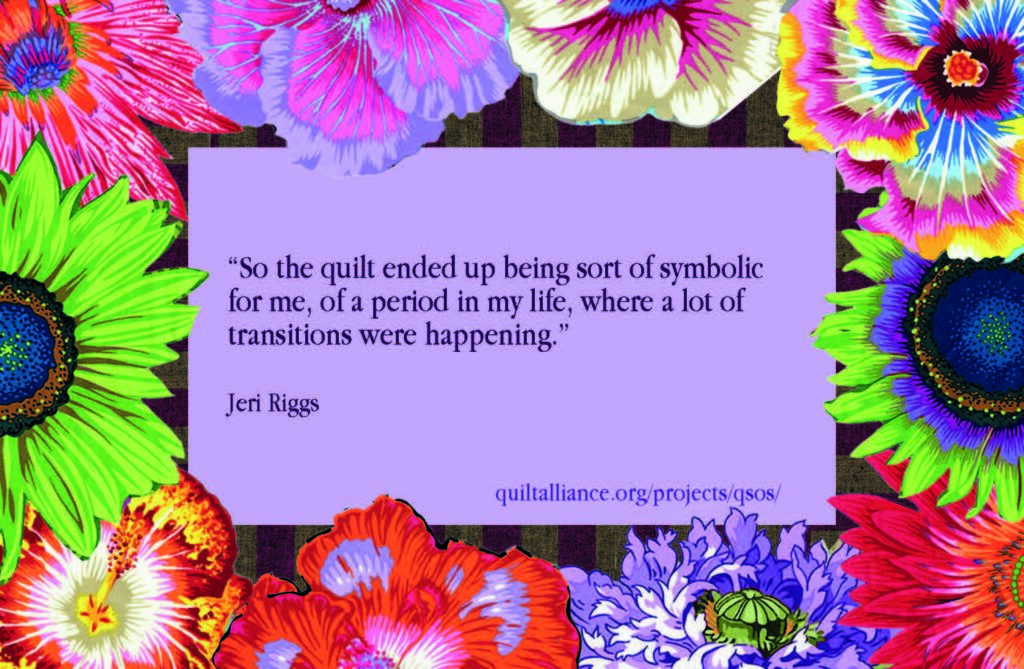
Similar to the women in our group, Riggs talks about the deeper meaning of her quilts: “so the quilt ended up being sort of symbolic for me, of a period in my life, where a lot of transitions were happening.” Responding to this quote and looking at the image of Riggs’ quilt we had printed off, a woman responded: “I think it’s symbolic of, feeling a little bit chaotic, but also colourful and creative and hopeful. Like if you really look at it, it says a lot, doesn’t it?”
The wording of ‘transition’ in this quate raised eyebrows in the group, linking to conversations we had had about attending creative groups in recovery services. One woman discussed her experience of working in and attending a rehab, where she felt it’s often the “first time […] you’re invited to be creative. It’s the first time any of us have ever really sat down with other people” to do creative work. She continues: “to get out of your comfort zone with other people around you and put something down. And what that does for your inner work and your neuroplasticity, and all of the stuff that comes with that is actually so much more than just sitting down and putting something on paper [or into fabric]. It’s the first time for many that they’ve exposed themselves in a way where you haven’t got the words to say things, but you’re putting it down.”
- Archive Identifier: QSOS-154
- The full interview transcript is available here: https://qsos.quiltalliance.org/items/show/2641
Stephanie Grissom: Below, we discuss quotes from a Quilters’ Save Our Stories interview with Stephanie Grissom, conducted by Karen Busgrave. The interview is about her quilt titled “American Renaissance”, part of the Barack Obama Quilt QSOS Collection. Learning to quilt later in life, with influence from her sister and art quilts, Grissom finds inspiration in her personal life, emotions, and social observations. She made this particular quilt following the presidential election in the USA in 2008, using simple methods and symbolism to create her representation of hope, rebirth, and a felt change in politics in her country.
Stephanie Grissom is a quilter that creates her pieces based on personal inspiration, emotions, and social observations. The artwork entitled American Renaissance is made after the U.S. elections of 2008, where the artist uses simple methods of quilt making as well as symbolism to create the quilt representing hope, rebirth, and change in politics. At first, the artist was fascinated with embellishment, but finally decided to make minimalist quilts, in order to convey messages and not decorate them. She learned to quilt late in her life, under the influence of her sister and art quilts, where fabric was viewed as artistic material.
In her interview, Grissom says: “In response to the question ‘what do you think makes an artistically powerful quilt?’: Sometimes it’s the quilt and sometimes it’s the story behind the quilt and sometimes it’s the quilt artist and their story.” Our quilt is filled to the brim with stories: the story of Sophia Anne Delaval and the stories of the women that were told while we were cutting out fabric, arranging flowers into our quilt top, or appliquéing the full quilt. The QR codes embedded within the quilt allow for the stories we are telling on this website to be a part of the quilt too, and the mini quilts hidden in the flower pockets of the quilt allow others to tell new stories every time the quilt is interacted with; inspired by the Q.S.O.S. archive.
While it is important to the project that the quilt tells the stories of the women who made it, we did not want to record the details of these stories. Instead, we want the fabrics, the choice in materials, the embellishments to speak standing by themselves. The process of making this quilt has been a joyful one, but the stories that were told while making it brought together varied experiences and emotions.The women who made this quilt were in recovery from addictions, and it can be “quite exposing to sit down and produce something that’s just you,” without substances.
As we were developing our design for the appliqué, we were moving the flowers and stars we had previously cut out around the quilt. Adding and removing them as we auditioned the fabrics and practiced balancing the shapes and colours. In this way we are perhaps similar to Grisson: understanding the fabrics we are working with as artistic material. Where we are different however is our fascination with embellishment. When she started making quilts, Grissom was fascinated with embellishment, but as she continued to quilt she learned she wanted to make more minimalist quilts – to convey a message, not decorate fabrics. Our quilt is quite different to this: colourful, decorative, loud. As one of the women said: “I think that’s, that screams me!” Perhaps our group is still in this early stage of quilt-making: none of the women who participated in the group had made a patchwork or appliqué quilt before. We kept adding and adding flowers and stars. The stars in particular were important, because they “are ours” (Angelika used scans of materials used by the women to create monoprints just a few weeks before to create new fabric, sublimation printed and then cut into shapes to appliqué onto our quilt).
- Archive Identifier: BOQ-025
- The full interview transcript is available here: https://qsos.quiltalliance.org/items/show/2578