We are Wildflower Women
Co-designing an interactive quilt about blossoming in recovery in collaboration with National Trust
We are wildflower women.
We are Wildflower Women celebrates women’s recovery, the blossoming of spring, and the strengthened connections that can be built through collective making. Working with a group of women in recovery, we co-created an interactive quilt inspired by themes of blossoming and rebirth as well as the history of National Trust’s Seaton Delaval Hall and transcripts from the Quilt Alliance’s Quilters’ Save Our Stories (Q.S.O.S.) archive.
Women in recovery, fine art students, historians at National Trust, a PhD student in feminist care ethics, and a collaborative craft researcher worked together to create an interactive art quilt that highlights the importance of gender-specific recovery services in the North East of England.
In response to the question ‘what do you think makes an artistically powerful quilt?’ in her interview by Karen Busgrave in the Q.S.O.S. archive, Stephanie Grissom replied: “sometimes it’s the quilt itself and sometimes it’s the story behind the quilt and sometimes it is the quilt artist and their story.” (archive identifier: BOQ-025). Our quilt is filled with stories – the story of Sophia Anne Delaval, the story of other quilters as they overcome hardships, and the many stories we shared while creating prints, cutting, beading, and arranging fabrics.
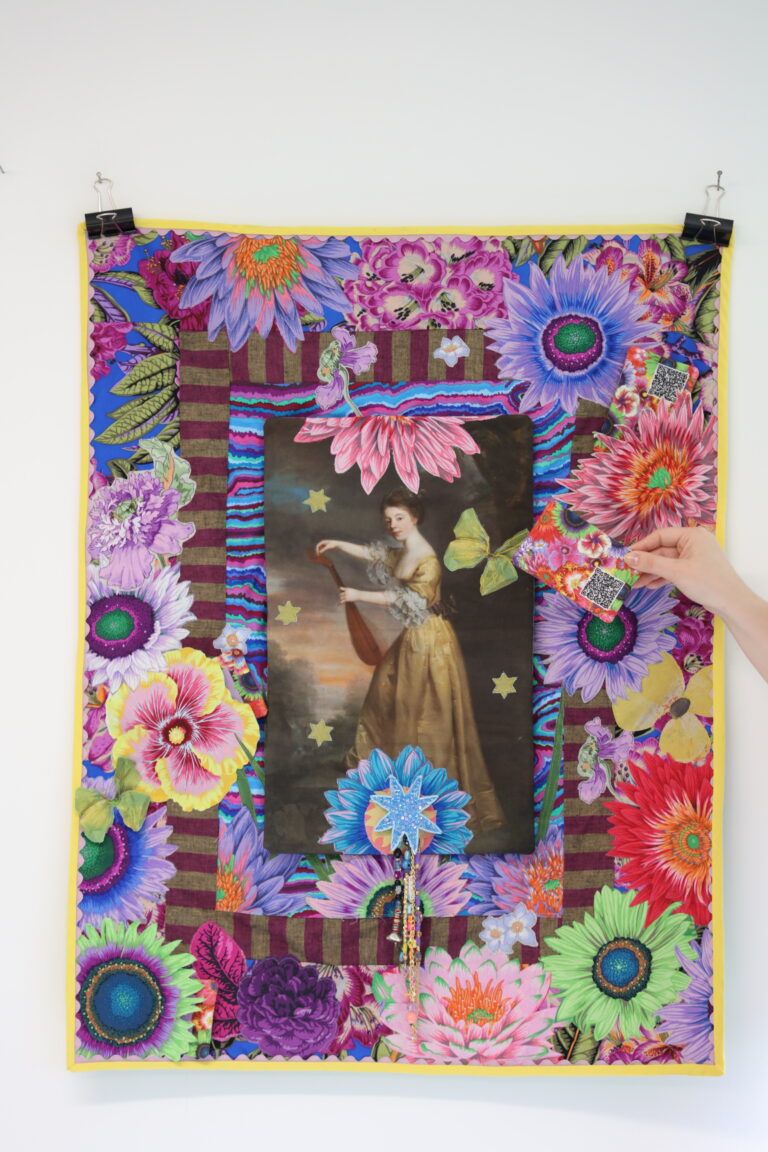
The quilt centres on the story and paintings of Sophia Anne Delaval (1755-1793). We started with an oil painting of her, made in 1770 by William Bell (1735-1794), that is on display in the Gallery at Seaton Delaval Hall (object number 1276754). Backed with a second fantasy painting of Sophia painted by Edward Alcock, dated 1775 – 1778 (object number 1276770), the painting creates a mini-quilt that can be lifted to reveal a poem written by a wildflower woman, Dee.
As Jeri Riggs says in her interview in the Q.S.O.S. archive, quilting is a “sense of daring. It’s a sense of wanting to try something different, sense of having your own individual vision that you want to create.” (archive identifier: QSOS-154) For our quilt, we dared to create together. To experiment with techniques we hadn’t used before. To be bright, colourful, and joyful.
Inspired by the Festival of Blossom and the nature around Seaton Delaval Hall, we selected various floral fabrics designed by the Kaffe Fassett Collective and used these to create an interesting pattern around the central motif; building a complicated patchwork of flowers on top of a medallion quilt base.
All of this is not in contrast to our exploration of the darknesses of Sophia’s story of addiction, losing care of her child, and experiencing harm from her husband – experiences members of our group had also experienced and are now recovering from. Instead, it is a response to the care and support that Sophia’s father gave her throughout her life, and that the family continued to provide to her son, Henry. It is a way for us to celebrate the joys of recovery, the community that we can build when making together, and the hope that is created in projects like these. As Rosa Angulo said in her interview in the Q.S.O.S. archive: “Hope. I always have hope.” (archive identifier: OH43040-002)
Time and time again, we hear stories that ‘women in recovery don’t engage in services’ or that ‘they have to want help’ – we say that this is not good enough. Instead, our project highlights that women will engage in recovery support that is developed with and by them, engage in support that is creative and adapted to their needs, and that gives space for them to learn new things with and from one another – spaces that allow women not only to survive, but to blossom!
Women in recovery engage. Women in recovery matter. Women in recovery care. And women in recovery heal together.
We are wildflower women, blossoming.
We are Wildflower Women.
This is an interactive multi-layered medallion quilt made by women in recovery, with support from a craft researcher, fine art students, a feminist care ethics researcher, and historians at National Trust.
When looked at in its initial stage, we see a painting of Sophia Anne Delaval as the central motif. The borders are covered in raw edge appliqué flowers as well as some stars. Some of the flowers act as pockets, within which 5 additional mini quilts are hidden. These are made up of purpose-designed fabrics, containing quotes from 3 transcripts within the Quilters’ Save Our Stories archive.
At the bottom of edige of the painting, we see a sparkling blue star with several chains and beads attached to it. When lifted, we see a second painting of Sophia Anne Delaval on the back of the first: a fantasy portrait of Sophia holding a Claude glass. Below these paintings, we see a poem written by Dee (one of hte women who participated in the project).
This quilt was exhibited at National Trust’s Seaton Delaval Hall between May and July 2026.
As part of the Ardis James QSOS scholars’ spotlight, Angelika gave a talk about this project in early 2026, before we completely finished the quilt. Her talk starts at the 40 min. mark in the below YouTube video.
This work was made possible with funding from the Quilt Alliance’s Ardis James Scholar programme, the Gendered Violence and Abuse Interdisciplinary Research Theme at Northumbria University, the Large Grant Support Fund at Northumbria University, and additional funds from National Trust’s Festival of Blossom programme.