
Aiming to make Cairo a more inclusive city for people of all genders and sexualities—across age, ability, class, religion, and economic background, this study builds on our research project Gender-Inclusive Cities by examining Cairo as a case study. Conducted in collaboration with the Cairo Safe City and Safe Public Spaces Programme, the project explored three neighbourhoods through the central question: who builds our cities, and for whom? This inquiry foregrounded the role of gender in shaping urban experiences. Research activities, led by urban scholars from Northumbria University, CLUSTER, and UN Women, engaged both online and on the ground with diverse communities in Zamalek, Al Manial, and As Sabityyah.
The project began with an online cross-cultural exchange between Egyptian and UK students of architecture and urban planning, aimed at challenging rigid assumptions about gender inequality. In a collaborative mapping workshop, students from both countries paired up to trace how they navigate the city in their daily lives. A seemingly simple prompt—“What goes through your mind when you step out at night?”—quickly revealed the complexity of gendered experiences and the multiplicity of identities, with the group brainstorming board filling within minutes. While Figure 1 illustrates clear differences in students’ personal experiences based on gender, the striking similarities between Egyptian and UK participants were equally revealing.
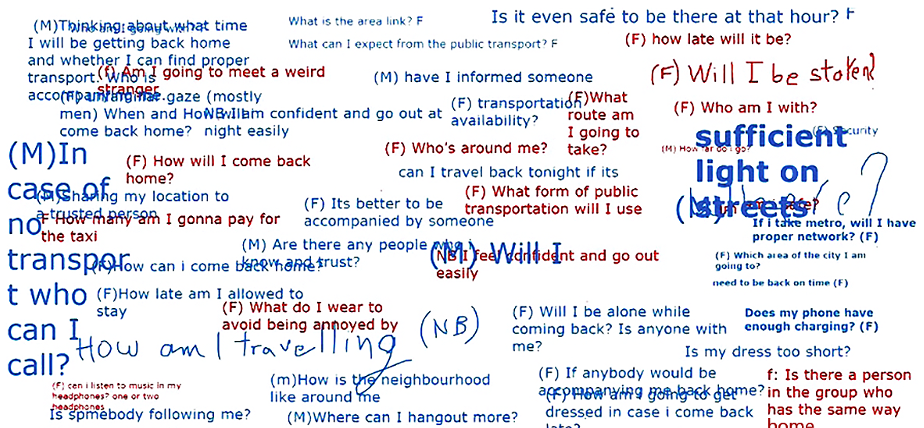
Figure 1. A collective response on ‘What do you think about when you step out at night?’ by Egyptian and UK students during the online mapping workshop. (Gender-inclusive Cities, 2022)
Seemingly simple questions—Is my phone charged so I can contact friends and family? Should I tell my family when I go out? What can I wear?—formed the starting point for the research team’s qualitative exploration of everyday urban life in the UK and Egypt. From these concrete concerns, the study moved step by step into a deeper analysis, carefully tracing how such ‘local’ gendered challenges are connected to, shaped by, and in turn reshape daily urban experiences. Intersectionality quickly emerged as a central theme. Following the workshop, student pairs shared collaborative reflections on their relationship with their city, which were later presented in a public exhibition. This phase also paved the way for on-ground engagement in Cairo, in which the participating Egyptian students took part over the following months
Neighbourhood-level interactions and co-planning sessions
The next phase of the project moved into on-street engagement, reaching out directly to people from diverse backgrounds. Over the course of a week in each neighbourhood, the research team—together with local partners and students—visited three selected areas carrying a large city map and asking a simple question: “Where do you like to go in your city?” From school walls to public parks, temples, and mosques, these maps were displayed in public spaces where passers-by could stop and contribute. Within hours, people marked their favourite places—the spots where they felt most comfortable and where they returned time and again, whether alone or with friends and family. Alongside the maps, a ballot chart invited participants to vote on what they value most in a public space: greenery, safety, seating, street food, shopping, freedom, scenic beauty, entertainment, toilets, accessibility, and more.
From these neighbourhood-level discussions, citywide patterns began to emerge, revealing how people from different backgrounds navigate Cairo and which public spaces feel most inclusive. Participants openly shared their gendered experiences and the barriers—physical, social, and economic—that shape their mobility.
In As Sabtiyyah, many women explained that religious spaces or local coffee shops were among the few places they felt “allowed” to go, unlike malls or other leisure sites. Women in Zamalek, by contrast, described their neighbourhood as relatively safer than most parts of the city, yet still vulnerable to late-night crime due to the lack of “eyes on the street” in its urban design. Across all four neighbourhoods, women highlighted the clear gender divisions in access to space:
“Many things here in Cairo are difficult for women. I don’t feel safe in public transportation unless I use women-only carriages. I hope to see buses cover all of Cairo, not just the popular spots.”
“Even during the day, I hesitate to walk alone in certain streets. The fear of being stared at or harassed never fully goes away.”
“I plan my route carefully when taking public transport, avoiding buses or metro lines that feel crowded or poorly monitored.”
“Even familiar neighbourhoods feel unpredictable at night. Street lighting and open sightlines can make the difference between feeling safe and vulnerable.”
“We see women struggling in all aspects. Even a simple walk down the street exposes them to harassment, verbal or even physical.”
“Certain public spaces are dominated by men, and it’s hard to feel like you truly belong or can claim that space.”
Unsurprisingly, sexual harassment and violence surfaced as the most pressing fears among women, reflecting the deep gendered power dynamics embedded in Cairo’s spatial design.
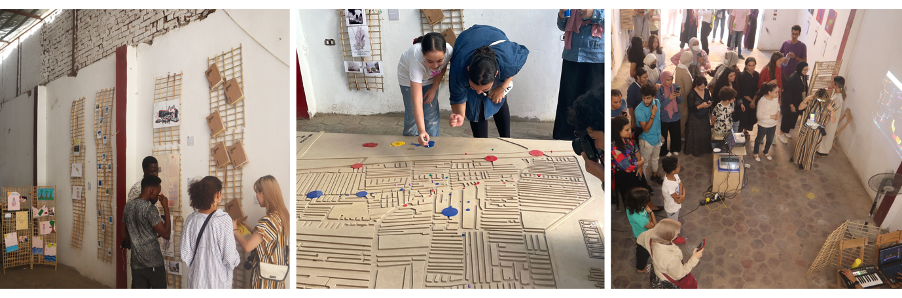
The maps and week-long conversations culminated in a public exhibition held over the weekend at a central, open-to-all venue in Cairo. Through placemaking, ordinary urban settings—an underpass, a pavement, the space beneath a metro line, areas around Bus Rapid Transit (BRT) stations, and the courtyards of cultural spaces—were transformed into vibrant festival grounds. These temporary public forums brought together people from across the city to engage in the project’s discussions, alongside cultural performances and artworks by local artists.
Interactive activities invited participants to share their own experiences of the city. These contributions revealed how everyday encounters often involve performances of superiority and deference, and how feelings of belonging—or exclusion—are shaped by gender and class. Such dynamics determine where individuals feel “at home” in Cairo, and how they are perceived and treated across its socially segmented map.
Visitors were also asked to imagine themselves as “mayor for a day,” proposing ideas to make their city more gender-inclusive. The resulting suggestions filled the festival spaces with both powerful and playful visions of urban change. Another activity mapped mobility patterns across the city by crowd-sourcing responses to questions about which public spaces people frequent most, when, and how they get there. Using coloured threads to connect these responses, participants collectively wove a citywide pattern of how different genders navigate and experience Cairo.
The summer workshops in Cairo highlighted how questions of gender, class, and mobility are deeply embedded in the everyday life of the city. Through cross-cultural exchanges, neighbourhood-level engagements, and public exhibitions, the project revealed both the barriers and possibilities of creating more inclusive urban spaces. By bringing diverse voices into dialogue including students, residents, artists, and policymakers, the workshops demonstrated how participatory methods can uncover hidden patterns of exclusion while also sparking new imaginaries for a city that works for all.
For further details, please refer to the publication:
Jin, J., Huang, K. & Zhu, M. (2023). Engendering the City: A Participatory Approach to Gender-Responsive Planning and Urban Design in Cairo. In: Asl, Moussa Pourya (ed.) Urban Poetics and Politics in Contemporary South Asia and the Middle East. Series: Advances in Religious and Cultural Studies (ARCS). IGI Global, pp. 269-290. DOI: https://doi.org/10.4018/978-1-6684-6650-6.ch013