
Despite decades of evidence documenting the exclusion and marginalisation of women in urban environments, progress towards more inclusive, gender-equitable planning remains slow. The feminiNE1 investigates the relationship between gender representation in planning authorities and the inclusivity of urban policies, using Newcastle upon Tyne, a rare case of a female-dominated city planning department, as a critical case study. This work explores how gender identity shapes urban experience and how structural planning processes either enable or inhibit inclusive outcomes. The research aims to generate actionable policy guidance for gender mainstreaming in the context of Newcastle’s forthcoming Local Plan 2045.
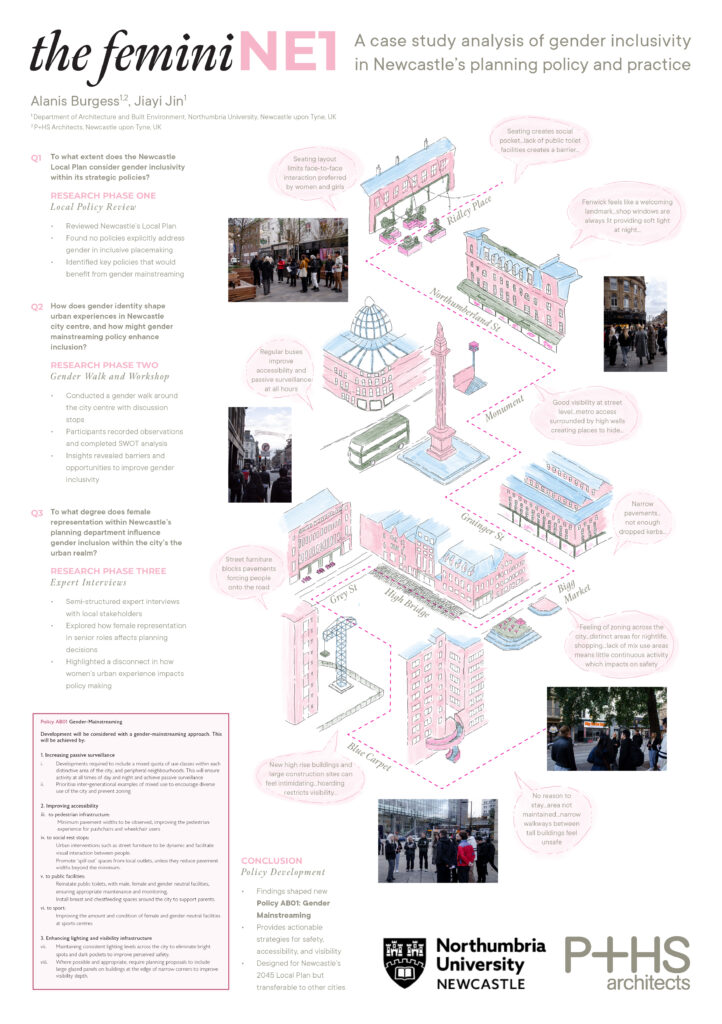
This research was led & delivered by Alanis Burgress and was selected as a featured study at the 10th Healthy City Design 2026 International Congress, held at The Lowry in MediaCity, Salford, Greater Manchester, on 20–21 October. The study adopted a transdisciplinary approach, drawing on gender theory, sociology, political science, and urban studies. A three-phase methodology was employed. The first phase comprised a comprehensive literature review alongside an in-depth analysis of local policy frameworks and design codes. Insights from this phase informed the design of a participatory gender walk and workshop, attended by academics, architects, and planning professionals in Newcastle. Findings were subsequently disseminated and critically examined through expert interviews with key local stakeholders, including senior planning officers from Newcastle City Council and a leading architect. Data from all three phases were iteratively synthesised into a gender-mainstreaming policy framework that is sensitive to place-specific conditions while remaining transferable beyond Newcastle and the North East.
Findings suggest that despite demographic shifts in Newcastle’s planning leadership creating space for new perspectives, structural planning processes continue to reproduce gendered biases. The participatory research methods employed in the gender walk and workshop highlighted persistent barriers for women in public spaces, including issues of safety, mobility and accessibility. Subsequent expert interviews underscored a disconnect between individual values and institutional practice, where progressive intentions are often constrained by rigid planning systems and policy legacies. However, the research also identified clear opportunities for intervention, particularly in embedding gender mainstreaming principles early in the policy design process.
The research concludes that while gender diversity within planning leadership is an important and necessary step towards progress, it is insufficient without accompanying structural reform. The study presents a context-sensitive gender mainstreaming framework for Newcastle with elements of broader applicability across the UK, contributing both practical guidance for policymakers and theoretical insight for the regeneration of our urban realm. By centring lived experience and feminist urban knowledge, the research advocates for embedding gender equity in planning practice, supporting healthier, more inclusive urban environments for all.