

Urban Context:
Newcastle upon Tyne presents a distinctive urban profile for applying a feminist urban design framework. As a post-industrial Northern city, Newcastle faces intersecting challenges, and all these challenges have gendered dimensions that standard urban assessments rarely capture.
Key contextual factors of this city include:
- Deprivation geography: Several wards in the West End and East End of Newcastle rank among the most deprived in England, where women, particularly lone parents, carers, and older women, face compounded vulnerability.
- Night-time economy: Newcastle’s prominent Bigg Market and Quayside nightlife zones create specific safety concerns for women and LGBTQ+ individuals, with particular risks around poorly lit routes, inadequate transport provision late at night, and street harassment (high crime reports).
- Care infrastructure gaps: Despite significant public sector employment among women, childcare provision, elder care access, and refuge services are unevenly distributed.
- Transport: Tyne and Wear Metro and bus networks serve commuter patterns that largely reflect a male, 9-to-5 work model, failing to accommodate the trip-chaining behaviour common among women balancing paid work with care responsibilities.
- Regeneration pressure: Major developments in the city risk displacing existing communities and erasing informal care networks that women depend on.
Our Research Approaches:
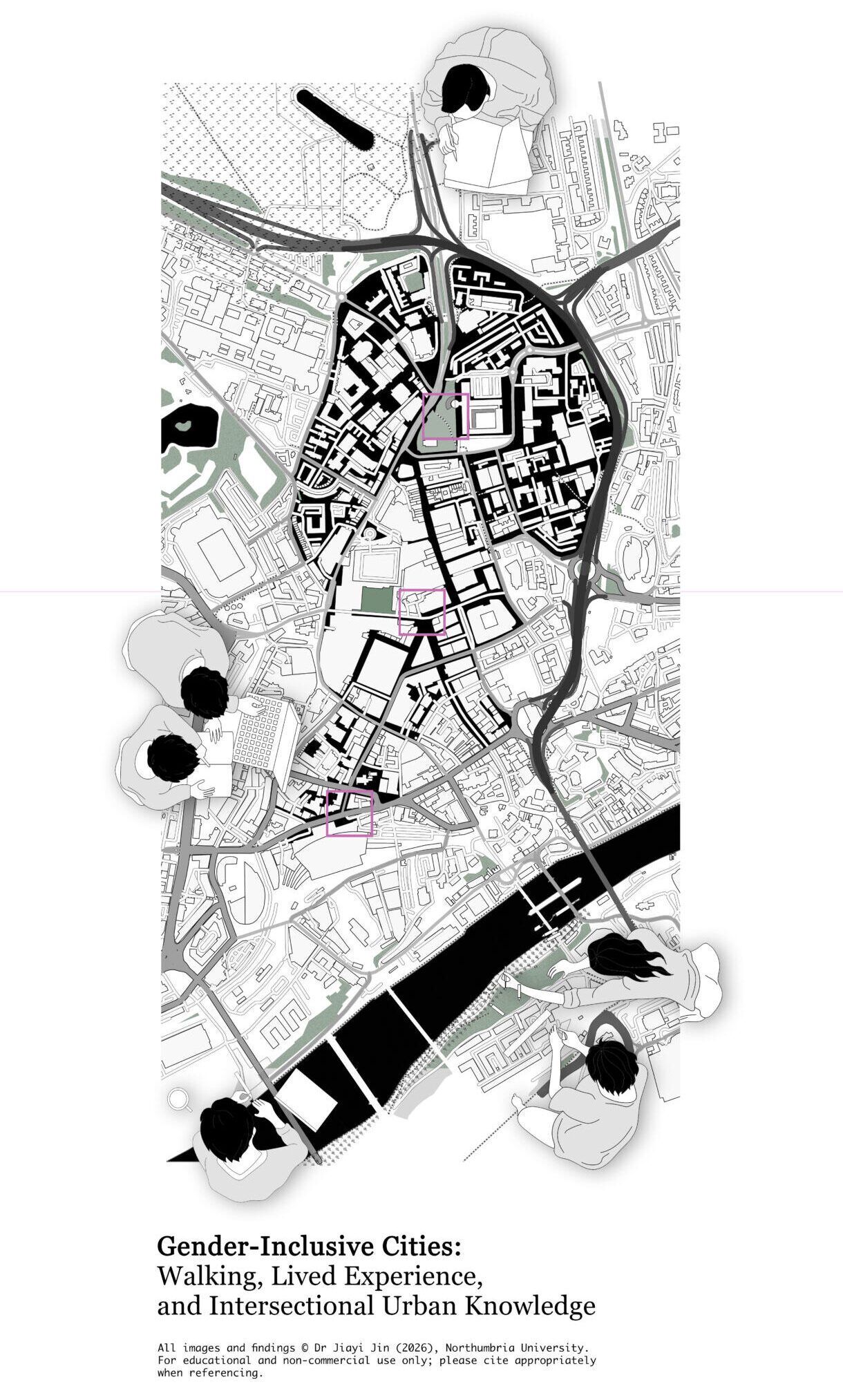
The Gender-inclusive Cities project began in 2022. Over the past four years, we have conducted gender walks, interviews, and focus groups, engaging around 300 participants from across the city. These participants include representatives from the public sector, urban designers, architects, property developers, police, and community charities.
Our research has generated qualitative insights into how women modify their behaviour in the city—such as avoiding certain routes, times, or areas—due to safety concerns. We have also adopted community-led participatory mapping to document women’s experiences of Newcastle’s public realm, building on approaches developed in Barcelona’s feminist urbanism programme.
Further details on each study can be found in our publications.
Design Recommendations:
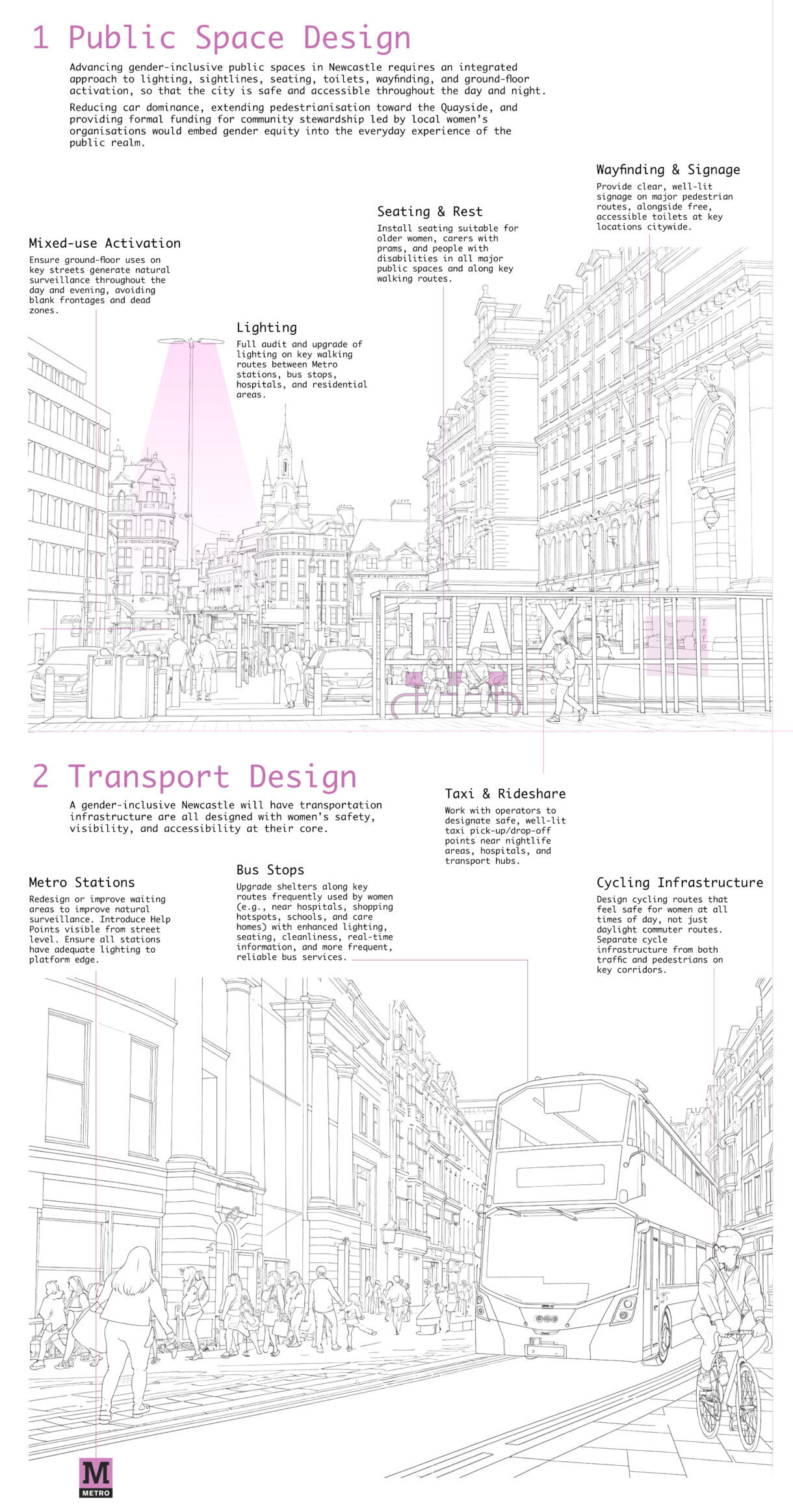
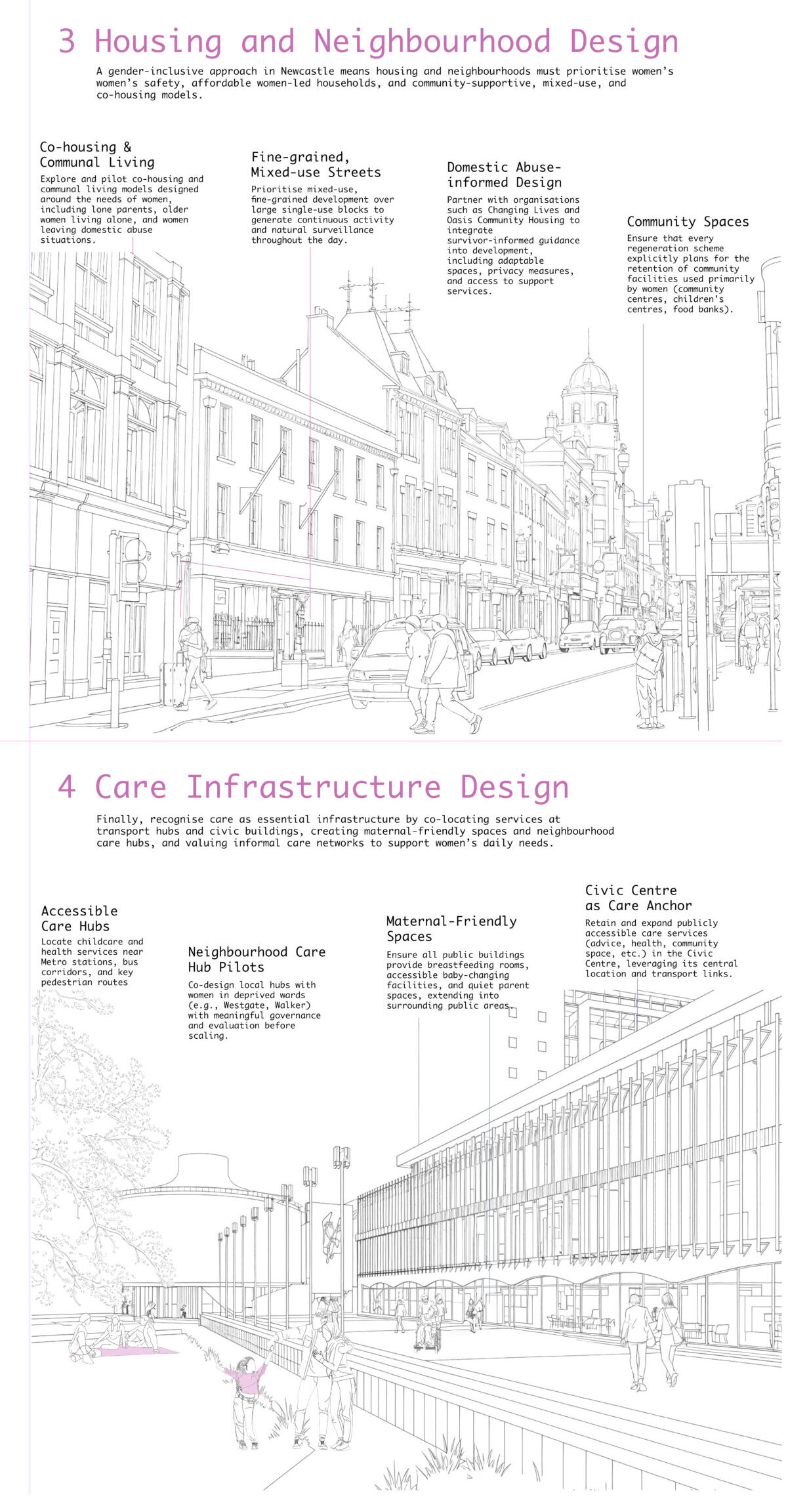
Policy Recommendations:
Gender-Responsive Budgeting: Council budget decisions above a defined threshold should require a published gender impact assessment. This is particularly urgent given continued cuts to social care, libraries, and community services.
Transport Poverty Strategy: Develop a dedicated strategy addressing the gendered dimensions of transport poverty, in partnership with Nexus, Combined Authority, and bus operators.
Care Economy Recognition: Formally recognise the care economy in Newcastle’s Economic Strategy, including investment in care infrastructure as economic development, not just social policy.
Data Governance: Establish a Gender Data Governance Framework, mandating that all Council data collections are disaggregated by gender, and that data is published openly and accessibly. Partner with two universities to build analytical capacity.
Night-Time Economy Licensing Policy: Reform licensing conditions to require venues to demonstrate gender safety measures (safe spaces, staff training, lighting, transport links).
Community Engagement Recommendations:
Establish a Newcastle Women’s Urbanism Forum — a permanent advisory body of women residents, drawn from all wards and reflecting the city’s diversity to scrutinise planning and policy decisions.
Run participatory mapping workshops in partnership with community anchors in the West End, East End, and outer estates, using methods accessible to women with limited time, language barriers, or caring responsibilities.
Fund women’s organisations as data collectors and community researchers, building on their existing trust relationships.
More exhibitions and events similar to How We Live Now – Making Spaces in the North East, previously held at the Farrell Centre at Newcastle University with the Matrix Feminist Design Co-operative, have explored how feminist approaches can reshape architecture and urban space.
Acknowledgement: The author would like to sincerely thank all participants for their valuable contributions to this research.