
BEHIND THE SCENES
How we worked with Claude.ai

Starting with the Conference Theme
From the moment we decided to host the ServDes Community in the North East in the UK, we puzzled over how to engage researchers, practitioners, and educators around meaningful, timely and relevant issues of designing services today. We did not want to avoid the many clouds we find hanging over the world and that challenge some of our key concepts and assumptions of design. Instead, we wanted to find ways to explore and address them together to find ways forward. We arrived at the concept of shadows as a broad umbrella that allowed us to reflect on less visible or even invisible services. Through imagery and stories, we unpacked shadows, their forms, uses, and functions from theatre to nature, from protection to power. This left us with questions that now frame the conference: What shadows can we find in service design? How might we cope with them? How do they influence our work across the many dimensions of services in public and private contexts? Thus, the conference theme ‘Designing in the shadows: places and practices of service design in a polarised world’ was born.
Exploration and Curiosity that ends with a poem
Only after the conference theme was in place and after our own explorations into the pluralistic nature of shadows had advanced, did we bring in Claude.ai (Sonnet 4.5). We thought it a fun exercise driven by curiosity if it would add anything to our theme. Encouraged by our university which had provided us with access, this was an opportunity for playful engagement. Already, AI was throwing its own shadows on services and service design, both as a place and as a practice. Our engagement with Claude affirmed our hunch that Ai tools themselves present a new kind of service, one that lives in the shadows and one the ServDes community cannot ignore. These initial questions guided us:
Could Claude.ai help us deepen our understanding? Could it help us learn more about shadows beyond black and white, shades of grey? How would it maintain the notion of black and white and reconcile it with contrasting characteristics, qualities, and roles of shadows (hiding/protecting; places to do good/places to do harm; safe space/unseen space; shades of grey/bright colours)?
We started by training Claude on our own findings and research into shadows up to this point. Our prompts drew on the conversations and exchanges on the ServDes2027 Miro Board, which included an image board where we gathered and exemplified different kinds of shadows through our own photographs, taken over time and without any inkling they may one day inform a conference. One of the co-chairs had already employed ChatGPT for generating Haiku’s (Japanese three-line poems) from oral input through voice assistants in a prior research project. She was curious what Claude.ai would produce if challenged to write a poem based on the training up to that point and whose title was to be “From the shadows…”. The resulting poem was both beautiful and powerful. We were particularly impressed how it brought together the lingering concepts while maintaining the many possibilities shadows present.
Exploration and Curiosity that ends with an image
For the second exploration, we approached Claude.ai (Sonnet 4.5) with a request to draw an image that represents “designing in the shadows”. This was part of our quest for a conference logo, and accompanying website images. Interestingly, Claude.ai produced an initial image that stuck to the confines of the (culturally) dominant concept of shadows as black and white, with some shades of grey. Only after requesting another draft asking for colourful shadows did Claude.ai generate an image with lights in the dark. We found it reminiscent of the darkness of deep-sea water where fish and other creatures have adjusted with their own light production (think of an angler fish). We had not thought of a deep-sea metaphor before. Claude.ai did not mention it. But the collaboration based on curiosity did open this new path for exploration for us. Is this a service? We might conclude it is.
Clarifying and Refining Co-Developed Conference Tracks and Subthemes
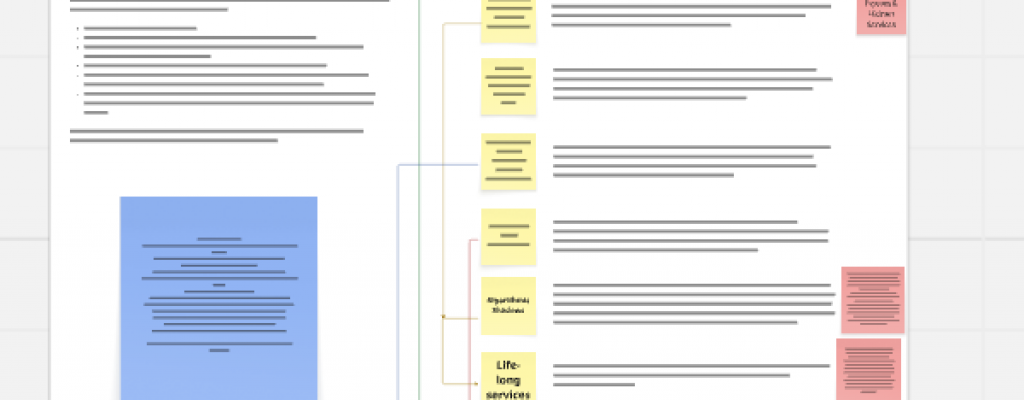
ServDes2027 like all academic conferences come into being through collaboration. Accordingly, co-design ensures buy-in and relevance to those who are spending their time organizing and running it. Co-Design also poses the challenge to align many divergent ideas, viewpoints, and interests with a stated conference theme. The conference co-chairs ended up with fifteen sometimes overlapping yet different conference track proposals. To run a manageable conference, we needed to reduce their number to 6-8 without losing any of the questions and problems colleagues sought to engage with. We sought to provide clear boundaries between often related and intertwined subjects and actors. Simultaneously, we aimed to keep it academic yet accessible to an interdisciplinary audience as we sought to draw in researchers and practitioners currently ‘lurking’ in the shadows of Service Design. We started clustering the fifteen tracks on the Miro board, grouping tracks thematically and conceptually with the conference theme we all had agreed on. Then we turned to Claude.ai again. By then, we had learned how to work with Claude.ai’s Sonnet 4.5 reasoning. Now we shifted to Claude.Ai Opus.4.6 (updated since to 4.7) which could support more powerful and deeper research. Though slower in its response it scoured more deeply and drew a wider net.
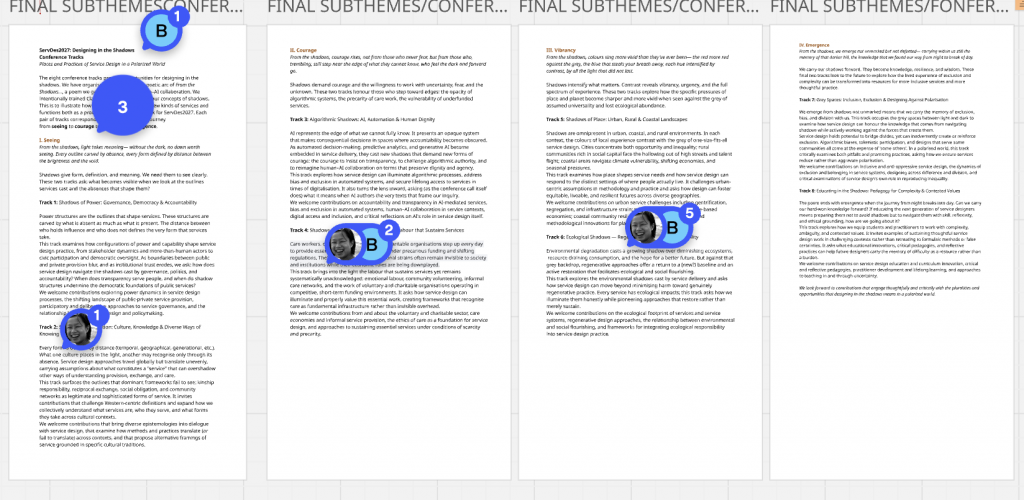
Claude.ai was already primed through our previous collaborations (the poem and the image). We had provided Claude.ai (Opus 4.6) with our conference theme, our call for paper and our research into shadows. Together, these created and presented guidelines for the prompt to take the fifteen different track proposals and convert them to eight distinct tracks without losing the essential characteristics we were after. The result was stunning and convincing: Claude.ai had returned to the poem and had started to ‘filter’ and ‘cluster’ the essential elements of the fifteen tracks along the verse lines of the poem. It still required some adjustments and adaptions by the co-chairs (mostly clarifications and language issues), but the conference tracks for ServDes2027 reflect Claude.ai’s proposal.
Why would we do this?
As mentioned above, the initial motivation was one of curiosity and exploration. However, from the start we emphasized that new technologies are shaping services and service design already. In employing Claude.ai for this conference in the way we did, we sought to offer both a provocation and a reality-check. We discussed how to make the use of AI transparent in a way that will inform the conference discussions and advance out understanding in the field. We do not know how many service designers, be they in research, education or practice, already make use of ai tools in their work. We are about to find out, for sure. In the meantime, we wanted to share our approach to invite those who have yet to engage with these new technologies to get a sense of what can be done and how. We have taken screen shots for our prompts and we are sharing them below.
Lesson 1: The initial prompting for the poem seems to have been lost – as there was no plan at the time for either using the poem itself or the Claude prompts for the conference. This is a lesson in itself: if you intent to document, do it from the start!
Lesson 2: Despite Claude having authored the poem “from the shadows” it did not recognise itself as its author when we fed it back later during the conference track development prompts. Lesson: it does not only deny credits to work by humans, it denies credit to itself.
Lesson 3: Not being able or not being willing to reveal itself as an author underlines the shadowy activity of AI. Lesson: We may struggle to know or realize when Ai comes up with something on its own.
Lesson 4: We saved ourselves a massive amount of time. As the Miro Board shows (pictures above), some of the themes Claude came up with were already on the board, sometimes implicit, sometimes actual. But to arrive at the outcome we achieved working with Claude.ai would have taken us days. Instead, it took one morning. Lesson: It will be impossible to ignore Ai for productivity gains in design. Not having access will lead to new inequalities.
Lesson 5: It turns out that designers and others versed in qualitative research involving open-ended interviews and conversations are well prepared to make the best out of Chat tools (ChatGpt, Kimmie, Claude, etc.). The more one can engage the tool, the better the responses and outcomes are. Every conversation is contextual.
We feel that the quality of our inputs mattered, helped train and prime the tool to give us what we were after. Because we are confident about our own input and about our own background research, we also feel justified to take advantage of this Ai capability.
Here are some things that may be useful to get started:
- Decide on an ai.tool.
- Check which version of that tool you have access too, and which one you want to use. The differences are usually speed and depth.
- Present yourself and your work to the ai.tool: who are you, what is your background, what do you want to work on, etc. (This is tricky and can open ethical dilemmas: do not feed it with anything personal about you and definitely not others)
- Describe the ‘project’ you want to work on with the ai.tool: I am co-chairing a conference, I am working on a proposal, … Explain the field, key figures and authors so Claude can match expectations.
- Provide context for this work: Attractive to international interdisciplinary researchers, academics, professionals, etc.
- Train it and prime it with your own concepts and ideas
- Share published papers, works, references with it that put it on the right track. You can feed in your own notes and thoughts, but be aware that once it is out there it stays out there.
What are the downsides or pitfalls?
- you need to have a clear vision of your vision, topic, theme
- you need to counter the temptation for Ai to take over: Do remain in charge
- you need to double-check for any misinterpretation that you might want to correct
- you need to check on the sources it is using
- you need to disclose how you use an Ai tool
Unsurprisingly, Claude was always very supportive of our ideas and engaged us with positive and encouraging feedback. Everything we entered and submitted was taken on with bravado: “what a great idea”, “what a strong argument”, “what a unique perspective”, etc. Although the positive psychology was encouraging, we acknowledge how important it was to ask the organising committee and colleagues to act as critical friends in assessing the outputs during this exploratory process.
Ethical issues
Just like we may not be able to access public (and/or private) services without being able to use digital apps, the design of services is likely to require capabilities to work with ai tools. We find this an emerging ethical issue that does not bode well for inclusion and equitable access.
We were surprised by the fact that Claude did not recognize itself as an author of the poem it had produced. Perhaps the use of two different versions (Sonnet 4.5 for the poem, Opus 4.6 for the conference tracks) has led to this. Either way, it pushes to the fore that at this stage, an ai.tool does not (or cannot?) remember the source from which it draws. If this were a human poet, the ai.tool would actively move that poet into a new shadow, making this person invisible and separating it from their work. This then demonstrates why the use of Ai tools for our conference serves both as a provocation and as a reality check.
ServDes 2027 Co-Chairs, Sabine Junginger and Joyce Yee, May 2026