
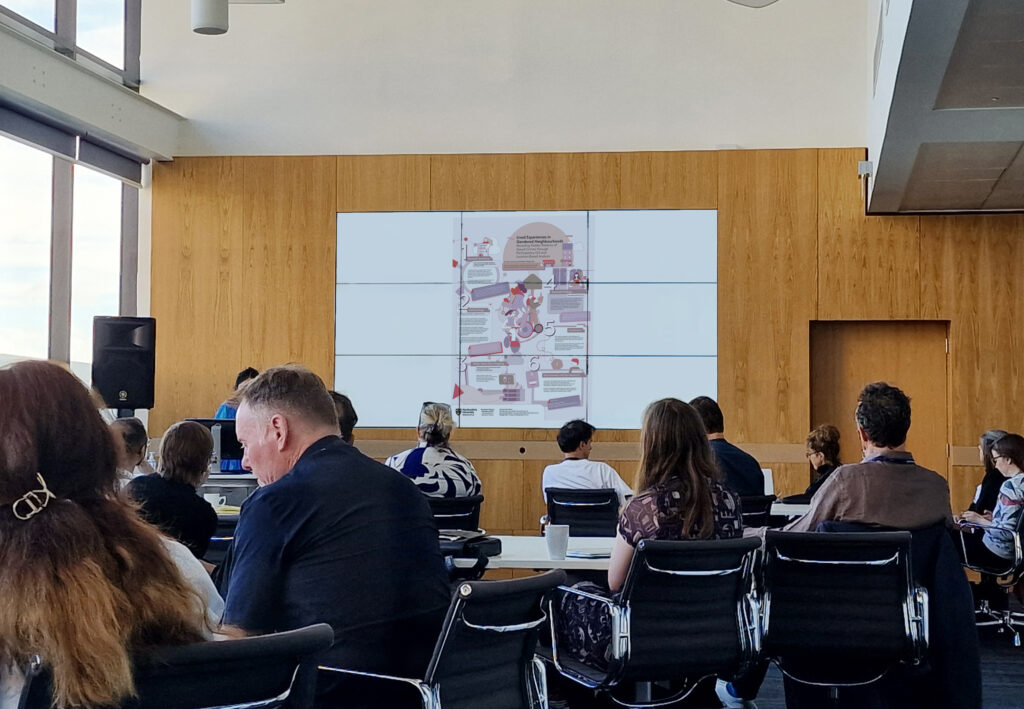
In September 2025, Dr Jiayi Jin presented the study at the University of Strathclyde’s Technology & Innovation Centre to share the latest research that’s changing how researchers view urban safety and gender. The presentation, “Lived Experiences in Gendered Neighbourhoods – Revealing Hidden Patterns of Sexual Crimes through Participatory GIS and Location-based Analysis”, offered some insights into a challenge cities worldwide are grappling with: creating truly safe spaces for everyone. This work forms part of the “Gender-inclusive Cities” initiative, and it’s also a side project supported by Northumbria University’s Urban Futures IDRT programme, which focuses on integrating gender mainstreaming into urban development strategies.
Why This Matters
Understanding gendered experiences in urban environments requires examining the complex relationships between how cities are physically built and how people actually use these spaces. Dr Jin’s research tackles three interconnected dimensions that shape our urban experience: First, there are the physical characteristics – the distribution, shape, and size of buildings and structures that define our neighbourhoods and everyday-life experiences. Second, we will need to consider user patterns – how different groups move through and occupy spaces, revealing social hierarchies and mobility flows. Finally, there’s the perceived social landscape – how people interpret and experience particular locations based on these physical and social factors.
The Masculine City
As other research has shown, urban spaces are often designed through a predominantly masculine lens. This goes beyond questions of aesthetics to affect whose needs, safety concerns, and everyday routines are prioritised in planning decisions. Kneeshaw’s research identifies a key consequence of this imbalance: when women and girls are excluded from urban planning processes, an “awareness gap” emerges. Decision-makers fail to understand why certain groups avoid public spaces, leading to misinformed or ineffective interventions.
As a result, women increasingly withdraw from public spaces that are intended to be shared by all. A stark example is the widespread avoidance of public parks by women, as these spaces have become associated with crime and fear. This pattern is reflected in our research in the West End of Newcastle (Elswick, Wingrove, and Arthurs Hill). Areas originally designed as inclusive gathering places for diverse urban communities have instead become spaces of exclusion, where many women feel unwelcome or unsafe.
Reaccessing Urban Inclusivity with Participatory GIS
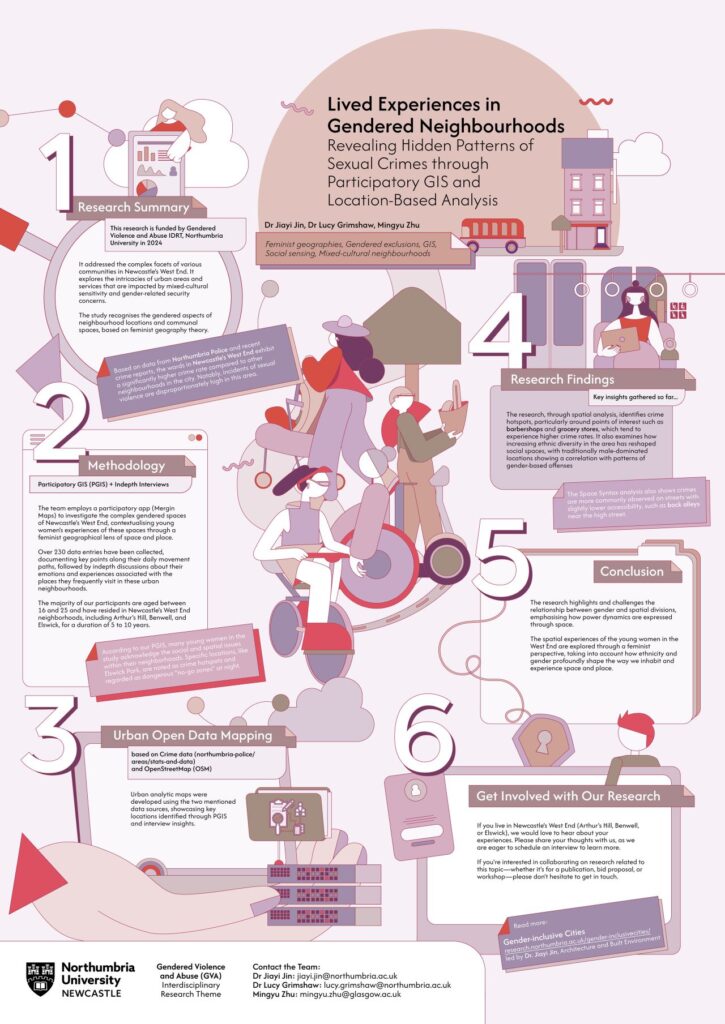
A truly inclusive city must be gender-conscious and actively committed to promoting gender equality. Without a deep understanding of the socio-spatial needs of women, cities will continue to function primarily as male-dominated environments. Through twelve months of engagement with women and girls in the West End of Newcastle—using in-depth interviews alongside GIS mapping for social sensing—we found that many participants develop their own mental maps of the city. These maps shape which places they avoid, which routes they prefer, and how they move through everyday urban spaces. Notably, these patterns differ markedly from those of male users, with clear implications for women’s daily mobility, access to services, and participation in public life.
We found that these differences are significant because women’s urban experiences are fundamentally distinct from those of men, and are further intensified in communities characterised by cultural diversity. Women’s navigation of the built environment is shaped by gendered patterns of use, cultural norms, social roles, and caring responsibilities, alongside persistent concerns about personal safety. Together, these factors influence not only where women go, but also when they travel, how they move through the city, and, in some cases, whether they use public spaces at all.
Our research, employing participatory GIS and location-based analysis, represents a critical step towards making these hidden experiences visible. By mapping perceptions of risk, unsafe spaces, and sexual crime through the lived experiences of those most affected, this work provides planners and policymakers with concrete, place-specific evidence. This evidence is essential for designing interventions that respond to real needs rather than assumed ones. Ultimately, the pursuit of gender-inclusive cities is not only a question of equity, but of creating urban environments in which all residents can move freely, participate fully, and feel safe in spaces that should belong to everyone.
Impact & Engagement
The study has generated significant engagement and positive feedback from academic and professional audiences, particularly through the #WomenSpatialActivism workshop. Participants highlighted the innovation of the research in combining participatory GIS, location-based analysis, and lived experience to reveal gendered patterns of urban safety that are often overlooked in conventional planning approaches. The work was praised for its ability to translate women’s everyday spatial practices into actionable, place-specific evidence for planners and policymakers, helping to address persistent awareness gaps in gender mainstreaming. While grounded in Newcastle’s West End, the methodology was recognised as transferable across different urban contexts, reinforcing its relevance to wider debates on gender-inclusive and equitable urban development.