
Podcasting
One of the playful practices we support at Durham is podcasting. While I don’t want to get into gatekeeping terminology with this – an essential element of podcasting is that it _is_ playful. A podcast is in essence a conversation, which means that ideas can emerge through discussion, and there’s social construction of meaning. There’s also drama podcasts (so scripted but still dialogic). The other essential element is that it’s cast, i.e. disseminated publicly.
Podcasting for assessment
The reason why I think it’s useful to maintain these elements is that I think anyone who says they want their students to do a podcast for assessment etc, and then asks them to simply read out an essay which no-one else hears, is convincing themselves they’re doing something novel, when they’re not. An audio recording which isn’t a podcast isn’t assessing any different skills (apart from the basic one of being able to read out loud) and so isn’t providing any diversity in an assessment strategy. The only rationale for doing an audio recording of an essay is, seemingly, that you can mark it while doing the washing up.
How we recommend students are assessed using a podcast is to have the assessed student provide a peer with a set of questions, and then have an unscripted discussion where those questions are answered. So somewhere between a viva and a chat down the pub. It’s worked really well with students who aren’t used to writing or who aren’t comfortable with critical reflection. Through a dialogue they can often uncover ideas or express their thoughts in a way that they struggle with setting down on paper. Also through it being in their own voice literally, the ideas are therefore in their own voice figuratively, which is an aspect of writing it can take years to get to. In fact, traditionally teaching academic writing has been about eliminating the individual voice.
Podcasting for dissemination
Which is also why I’d recommend anyone who wants to write a chapter and finds they’re struggling with it to have a chat with someone about it and record it. The transcription of the chat is a great way to get started, and helps reintegrate an authentic voice into your writing. Works for me anyway. Here’s an example of us doing just that for a friend’s book chapter he was writing https://www.pedagodzilla.com/podcast/an-odyssey-through-virtual-reality/
In our workshops, and when I do one-to-one consultations, we touch on using it with students, but our focus is on how to use it in dissemination. It’s never for widescale audiences, in fact if you have more the 27 listeners you’re better than average. https://www.thepodcasthost.com/business-of-podcasting/27-downloads/
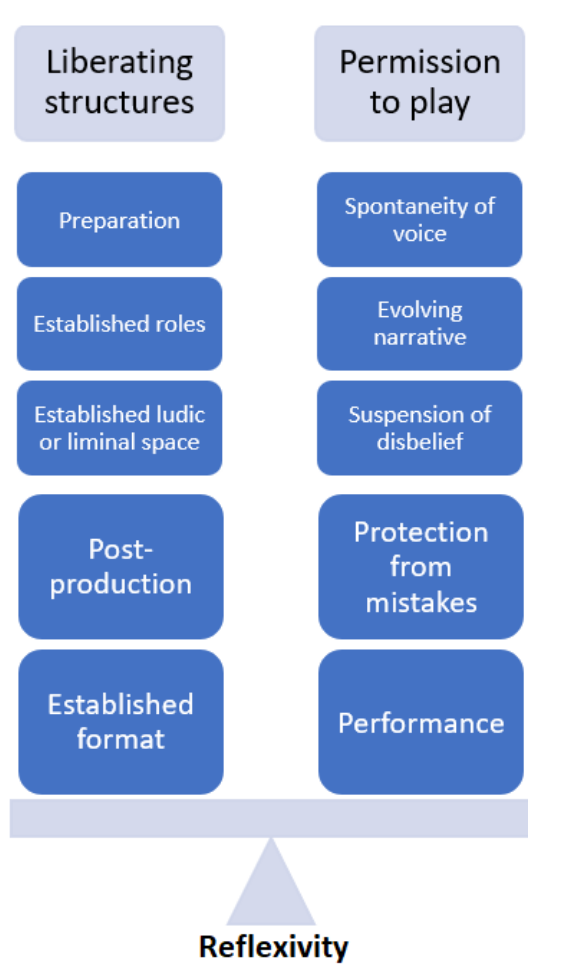
The value is to have a point of reflection, to connect to the few people who might be interested, and to keep your funders happy. We talk through the different types of podcast, and the different roles people have within them. We also talk through the balancing act between structure and chaos; the idea of liberating structures. That you put in enough structure to help guide the listener through your conversation, but leaving it loose enough so it’s still fun. Captured in this figure (from this paper https://www.journalofplayinadulthood.org.uk/article/id/1269/) .
But yes, we’ve found in our podcast that people like listening because it sounds like we’re having fun chatting to each other. If they learn something along the way, that’s a bonus, so we encourage the people we’re helping to set up their own podcasts to take the same approach.