
We have a monthly chat about critical pedagogy in our department and yesterday we got onto the topic of playful learning, and ice-breakers, and enforced fun and how it stops being fun when we’re told we’re going to have fun. All of which I really identify with.
We also explored whether play is intrinsically fun. At a workshop one of us attended the subject of experiences of play were discussed and no-one in my colleague’s group had entirely positive experiences of play. There was often a lot of bad experiences. I guess for me they’re almost entirely positive, which is why I’m drawn to playful learning. But then .. that’s a self-selected sample.
But then … is it intrinsically a part of play that it _needs_ to be fun. Suits in The Grasshopper talks about professional players, those that do it for some other reason – like to impress to people, or get on with them, or to earn money. They’re still playing – they might even be having fun, but having fun is not the motivation.
I’d argue, we don’t have to justify playful learning as fun in order to encourage people to want to do it. If it happens, bonus. But we’re not looking at this
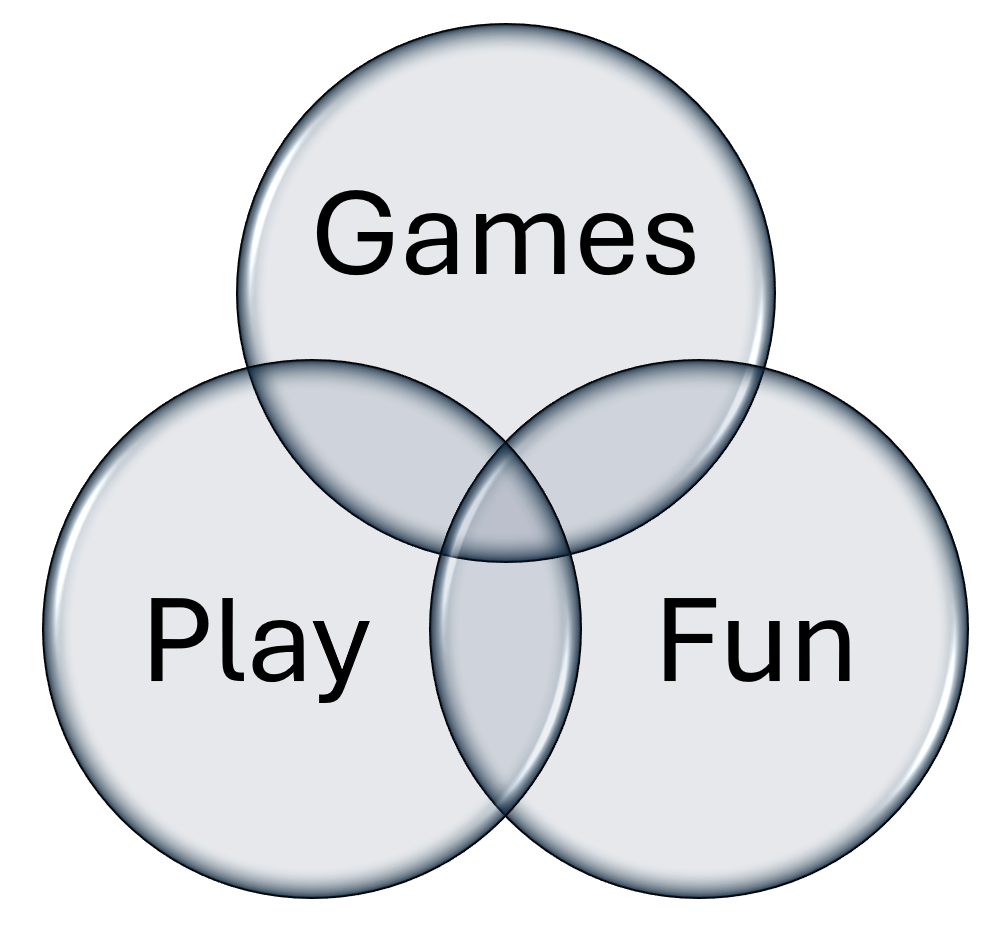
We’re looking at this – with the fun bit in the background and flattened out a bit

So what is play if it’s not fun? Well there’s another meaning of play
4. the space in or through which a mechanism can or does move.
“the steering rack was loose, and there was a little play”
And I think this also works – play is the giving of more space for movement, freedom to stretch about, or not fit quite and still work, a bit more tolerance (to use another term with a couple of meanings). Maybe crossing boundaries a bit. But I think telling people it’ll be fun is the best way to put people off. Like ice-breakers tend to have a bit of a chilling effect.