
Evaluating something that doesn’t exist yet: designing BEACON, a national evaluation of Neighbourhood Health
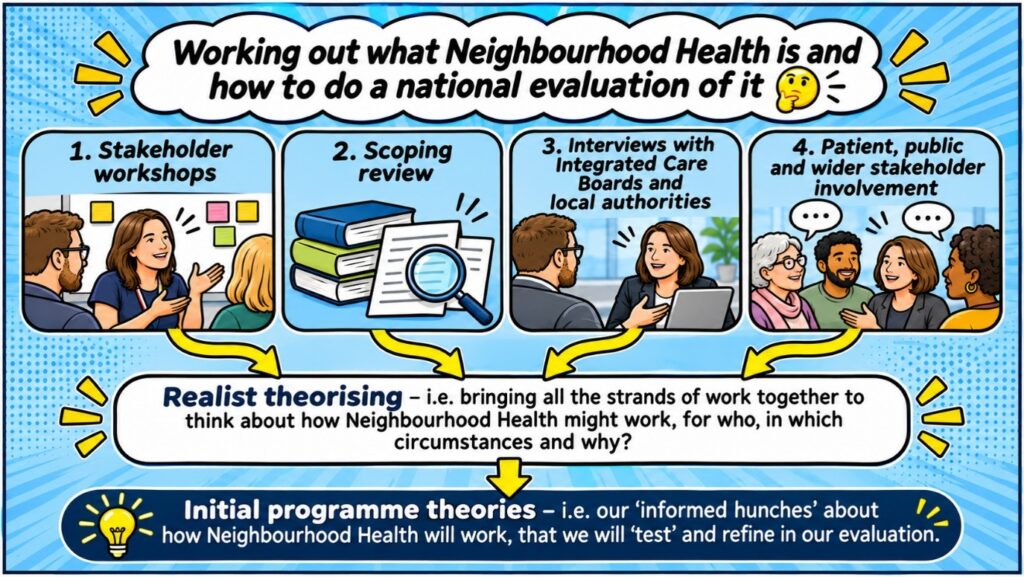
Author: IDEAS-NET Contact: ideas@northumbria.ac.uk If you’ve ever been asked to evaluate an intervention, you’ll know the usual starting point: someone tells you what the intervention is, who it’s for, and what it’s meant to achieve. But what happens when none of that is settled yet? That’s the situation we found ourselves in when designing an evaluation of Neighbourhood Health in England. Neighbourhood Health was introduced in England as part of the Ten Year Health Plan, and is seen as key to the plan’s success: “At its core, the neighbourhood health service will embody our new preventative principle that care should happen as locally as it can: digitally by default, in a patient’s home if possible, in a neighbourhood health centre when needed, in a hospital if necessary” (Ten Year Health Plan, pg. 9) However, Neighbourhood Health is not a single programme with a manual. It is a whole system change in which health, social care and voluntary sector organisations work together in a defined geographic area to provide integrated care and support; helping people to live healthier and more independent lives for as long as possible. Neighbourhood Health is still being designed, and it will look and be delivered differently in different areas. In this post, we share how we’ve approached that challenge in one of our evaluations. IDEAS-NET and BEACON IDEAS-NET (the interdisciplinary evaluation of complex innovations in health and social care National Evaluation Team) is based at Northumbria University, Newcastle upon Tyne, UK. Our job is to respond to the evaluation needs of policy makers, by evaluating national innovations in health and social care. One of those evaluations is BEACON: Building Evidence Around Community and Neighbourhood Health: A National Evaluation. BEACON aims to build national evidence on how Neighbourhood Health works, for whom, and in what circumstances. But before we could evaluate Neighbourhood Health, we had to work out what we were evaluating – this wasn’t as easy as it sounded! Neighbourhood Health is not well defined in the literature, where multiple definitions existed, or in practice, where it was interpreted in different ways. We needed to work out how to conceptualise Neighbourhood Health before we could make a meaningful evaluation of it. That meant a lot of work before we could even start the main study! Here, we explain four strands of work that helped us to conceptualise Neighbourhood Health and design our national evaluation: 1. Stakeholder workshops Neighbourhood Health belongs to many people, so we started by talking with them. We held three workshops between September and October 2025. Workshops 1 and 2 were online, and workshop 3 was run twice with different participants, once online and once in person. In total, 108 people took part. We deliberately brought together a wide range of perspectives: NHS staff from primary and secondary care NHS managers in provider and commissioning organisations Local authority and social care staff Voluntary, community, faith and social enterprise (VCFSE) staff People with lived experience of accessing health and social care services or of caring for people accessing care Researchers working on integrated care Policymakers What did this tell us? This gave us an early, shared understanding of what Neighbourhood Health should be and some initial insights into how things need to be organised in practice if Neighbourhood Health is to be successful. As well as informing the evaluation design, data from the workshops were analysed more formally and will be published soon. 2. Scoping review Next, we carried out a scoping review of peer-reviewed academic literature and other sources such as working papers and reports published by think tanks and working papers (these are called grey literature). The protocol for this review was registered with the Open Science Framework. Neighbourhood Health hasn’t yet “happened” at scale in England, but the review let us draw on closely related work to identify components that may underpin it. The purpose of the review was to identify and describe collaborative approaches where professionals from various sectors (such as health, social care and voluntary sectors) work together within a specific geographic area to provide integrated support to individuals. What did this tell us? The review identified and described components that may underpin Neighbourhood Health. These include funding realignment and resource pooling, relationship building and trust, multidisciplinary coordination, and reducing acute demand by shifting the focus of care. We’ll report on the full findings shortly. 3. Interviews with Integrated Care Boards and local authorities We spoke to people working in Integrated Care Boards (ICBs), local authorities, primary care, and hospital trusts who are developing and delivering Neighbourhood Health. We found participants through publicly available contact details and our own networks and completed 47 online interviews with participants from 25 Integrated Care Systems between June and September 2026. What did this tell us? These interviews gave us a clearer picture of how Neighbourhood Health is being interpreted and put into practice in different places. Interview participants told us about their early plans for Neighbourhood Health, their ambitions for how it could improve health and wellbeing in their local areas, and the challenges of delivering it in a health and care system under financial pressure. We are analysing the interview data and will share our findings in early 2027. 4. Patient, public and wider stakeholder involvement Alongside the Patient and Public Involvement and Engagement (PPIE) that took place in the stakeholder workshops, we also set up a stakeholder panel and PPIE group to work with us on the evaluation. We now have 128 people signed up to the stakeholder panel, including NHS staff representing primary and secondary care, ICB staff, local authority and mayoral authority staff including social care and public health, Voluntary Community Faith and Social Enterprise (VCFSE) staff, patients, carers and public contributors, academics and policymakers. The PPIE group has helped us to design the stakeholder workshops and consultation with individual patients and members of the public has also ensured diverse views are represented. This is work in progress as membership of our stakeholder panel and PPIE