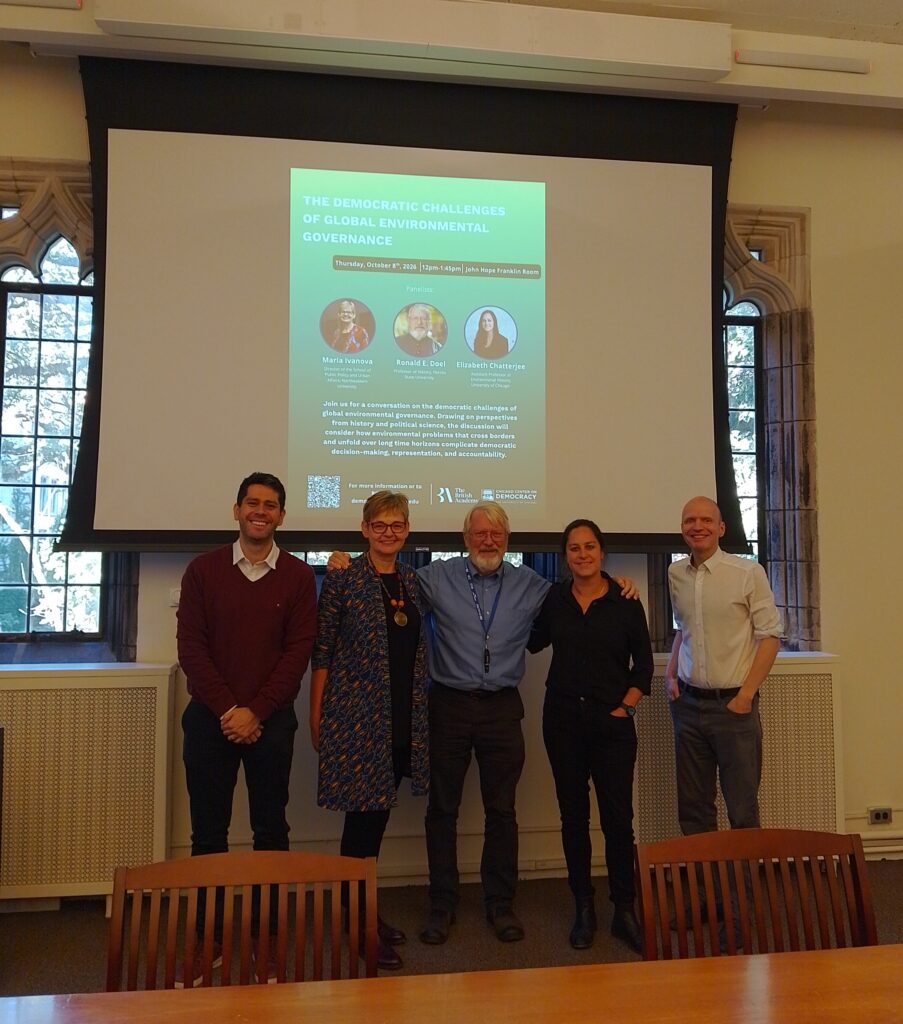
On October 8th, the HESG project held its first academic event at the Chicago Center on Democracy (University of Chicago), exploring “The Democratic Challenges of Global Environmental Governance”. In this post, its organizer Simón Ballesteros (Postdoctoral Scholar in Political Science at the University of Chicago) summarizes the discussions.
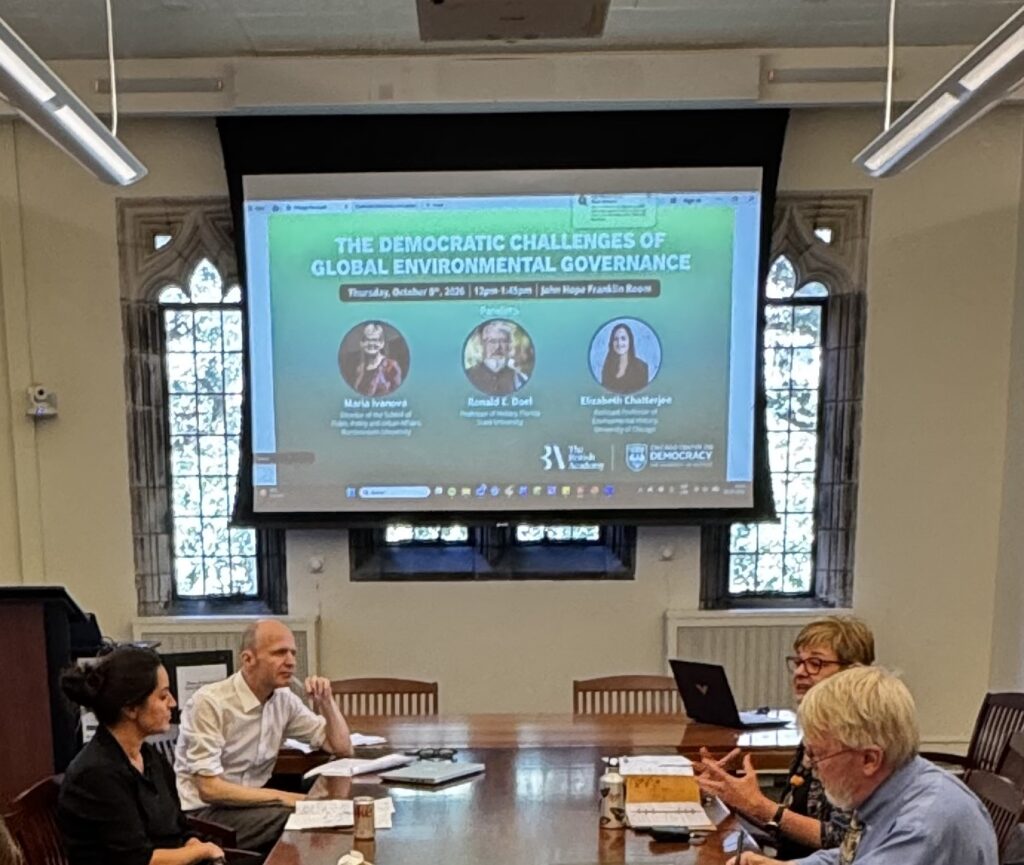
After introductory remarks by HESG coordinator Daniel Laqua and workshop convenor Simón Ballesteros, three leading scholars – Elizabeth Chatterjee, Ronald Doel, and Maria Ivanova – reflected on the tensions between domestic democracy, global governance, and tackling environmental challenges.
Elizabeth Chatterjee (Assistant Professor of Environmental History, University of Chicago) approached these tensions through the prism of India’s role in environmental politics, both at the national and international levels. In her presentation, she noted that the Global South has been partially successful in advancing some of its environmental demands, particularly in promoting the recognition of the right to development and the principle of common but differentiated responsibilities. Chatterjee also discussed how the environmental goals of political leaders influence national commitments, highlighting the central role of domestic politics in global environmental policy.
A different approach was offered by Ronald Doel (Professor in the Department of History at Florida State University). Through a series of historical examples – encompassing the politics behind the Chinese representation in international scientific initiatives (such as the International Geophysical Year), the development of scientific programmes in the Arctic as well as US science policy – Doel discussed the intertwined development of science and politics. He highlighted the opacity of these developments, which in some cases had significant consequences but remained largely outside public scrutiny. These examples illustrated how secrecy and political interests have historically shaped transparency and democratic oversight of scientific activities with potentially important environmental consequences.
Maria Ivanova (Director of the School of Public Policy and Urban Affairs as well as Professor of Public Policy at Northeastern University) approached these tensions from a policy perspective. She highlighted the critical role of institutions and leadership in global governance. In her account, global governance requires dialogue, coordination, and the ability to negotiate and reach agreements, sometimes even among actors whose positions on key environmental issues may, at first glance, seem irreconcilable. She emphasized that whether these efforts succeed or fail often depends on relationships, the agency of individual actors, and the informal politics of negotiation, dynamics that scholars in political science and international relations often miss in their search for generalizable explanations. She also urged academics in the social sciences and the humanities to contribute more to global policy debates and engage with actors involved in global environmental governance.
After these initial presentations, the panel adopted a more conversational format, in which the speakers, HESG members, and other participants shared their thoughts on the different dimensions in which these tensions appear in contemporary politics. Overall, this first panel provided an opportunity to discuss these challenges and laid the groundwork for future academic activities and collaboration under the HESG project.