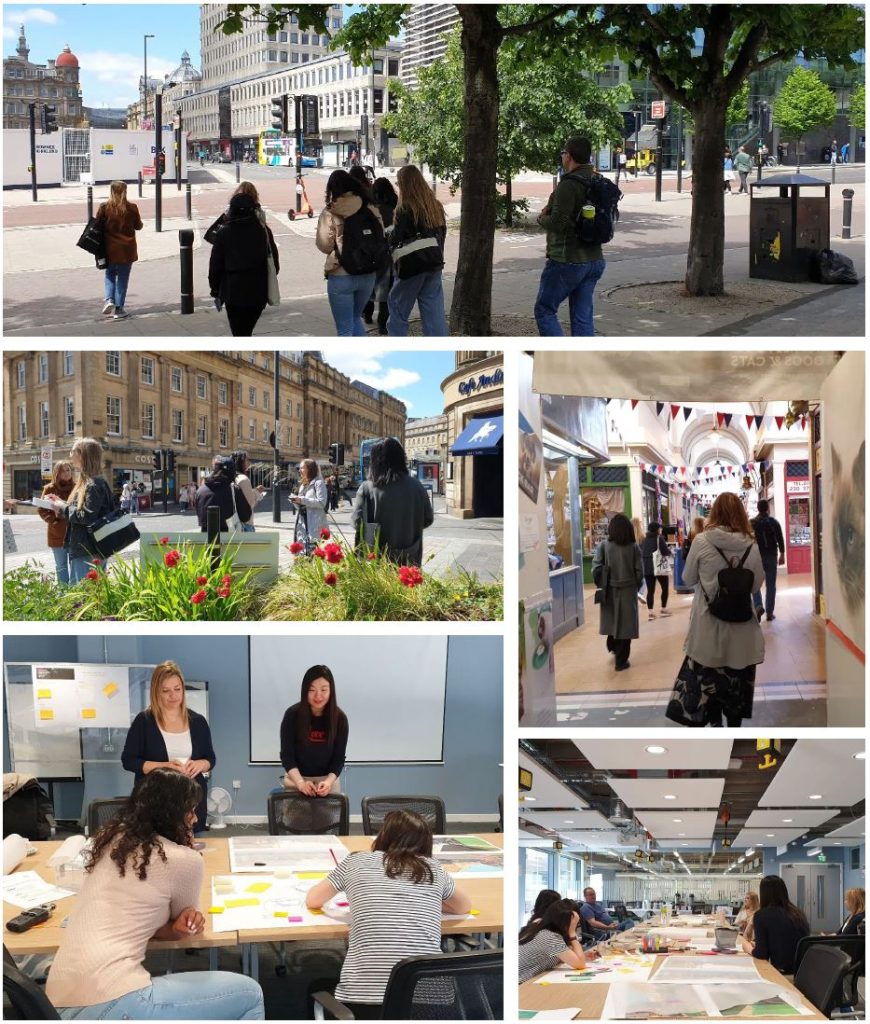
The gender walk began at the historic City Baths and was guided by researchers through a series of key locations in Newcastle city centre, including Ridley Place, Northumberland Street, Saville Row, Blackett Street, Old Eldon Square, Grainger Market, Grey Street, Pilgrim Street, and Northumbria University Library. The walk lasted for about an hour, during which participants shared observations, exchanged stories, and recorded their reflections on how the built environment shapes everyday experiences of accessibility, comfort, and belonging.
Following the walk, participants gathered for a workshop at Northumbria University Library. The session unfolded in several stages:
-
Mapping Reflections – Participants transferred their field notes and comments onto a large collective map, visually illustrating their perspectives on the routes and spaces encountered.
-
SWOT Analysis – In small groups, participants discussed the Strengths, Weaknesses, Opportunities, and Threats of Newcastle’s city centre architecture and urban design, creating a comparative chart of their insights.
-
Inclusive Futures Conversation – The groups came back together to exchange ideas about how Newcastle city centre might evolve into a more inclusive, diverse, and welcoming urban environment.
-
Researcher Reflections – The workshop concluded with researchers drawing out overlaps, contrasts, and synergies across the discussions, highlighting recurring themes and innovative ideas.
The combination of walking and structured dialogue revealed how gender, identity, and social background affect people’s experiences of public space. Many inspiring thoughts and practical suggestions emerged from the workshop, offering valuable insights for urban planners and designers seeking to create a city centre that reflects the needs and aspirations of its diverse communities.