
Past Events

Past Events

Counter fraud across the public sector: reflections from the GCFP conference and the SCAN project

How do public bodies with different remits, systems and priorities work together to tackle fraud, and what gets in the way? That question is at the centre of SCAN (Strengthening Counter Fraud Across the NHS in England), and it was a recurring theme at the Government Counter Fraud Profession (GCFP) annual conference, held in Leeds at the end of September. SCAN’s Co-Principal Investigator, Dr Cerian Griffiths, took part in the programme as a panellist, sharing SCAN’s findings with an audience of counter fraud professionals from across the sector. More than 250 members of the GCFP attended, and the programme showcased counter fraud work from across the public sector. Nick Tomlinson, Deputy Director, Building Counter Fraud Capability at the PSFA, opened the day by setting a tone of celebration, collaboration and reflection. Presentations and interactive activities followed, covering case studies from across the sector, examples of cross-body cooperation, the threats and potential of Artificial Intelligence, the challenges of creating counter fraud cultures, and developments in fraud control. One session illustrated the breadth of the work particularly well. Andrew Watson and Amanda Roberts of the Infected Blood Compensation Authority (IBCA) described introducing a counter fraud policy into an organisation working at pace. The IBCA has more than £11 billion to protect from fraud. Large sums intended for deserving recipients are attractive to fraudsters, so rigorous controls are essential. At the same time, many of those affected by the infected blood scandal have waited decades for compensation and some have little time left, so the IBCA aims to release funds quickly without placing excessive burdens on victims. The session showed how counter fraud controls and a compassionate, victim-centred culture can be designed to work together. Later in the day, Dr Griffiths joined a panel with members of City of London Police, the NHS Counter Fraud Authority, the Insolvency Service and the Public Sector Fraud Authority. Together with the wider audience, they discussed data sharing across public bodies, the continuing challenge of developing counter fraud cultures within institutions, and the opportunities and risks of Artificial Intelligence. These are difficult subjects, but the discussion pointed towards some practical routes forward. There was broad agreement that better data sharing between public bodies would help both to identify and to respond to fraud. Dr Griffiths shared some of SCAN’s findings on data sharing, including the importance of identifying and communicating the purposes of sharing early in discussions between bodies. SCAN’s findings on counter fraud culture also resonated with other panel members and the audience, particularly the importance of articulating the wider harms of fraud beyond the financial. These include reputational harm and, in the health sector, the threat to health and wellbeing. There was agreement that the consequences of fraud reach further than many colleagues in other parts of public bodies appreciate. Attendees left with plenty to reflect on and more conversations to be had. Some of those will continue at the SCAN project’s New Conversations in Counter Fraud across the Public Sector event on 21 January 2027. Practitioners, policymakers and researchers from across the public sector and higher education are invited to discuss current challenges, emerging risks and innovative approaches, test new ideas against frontline experience, share learning across sectors and build professional relationships that continue beyond the event. To submit a proposal, please email scan@northumbria.ac.uk. To register to attend, Click HERE To discuss ideas informally or ask questions, please contact Dr Cerian Griffiths at cerian.griffiths@northumbria.ac.uk. Event information New Conversations in Counter Fraud across the Public Sector Date: 21 January 2027 Time: 09:30 to 17:00, with drinks reception to follow Location: The Great Hall, Sutherland Building, Northumbria University, NE1 8ST INFORMATION / REGISTRATION *This project is funded by the NIHR Health and Social Care Delivery Research programme (NIHR159714). The views expressed are those of the author(s) and not necessarily those of the NIHR or the Department of Health and Social Care.
Past Events

SCAN – Eurocrim 2026 Conference Report

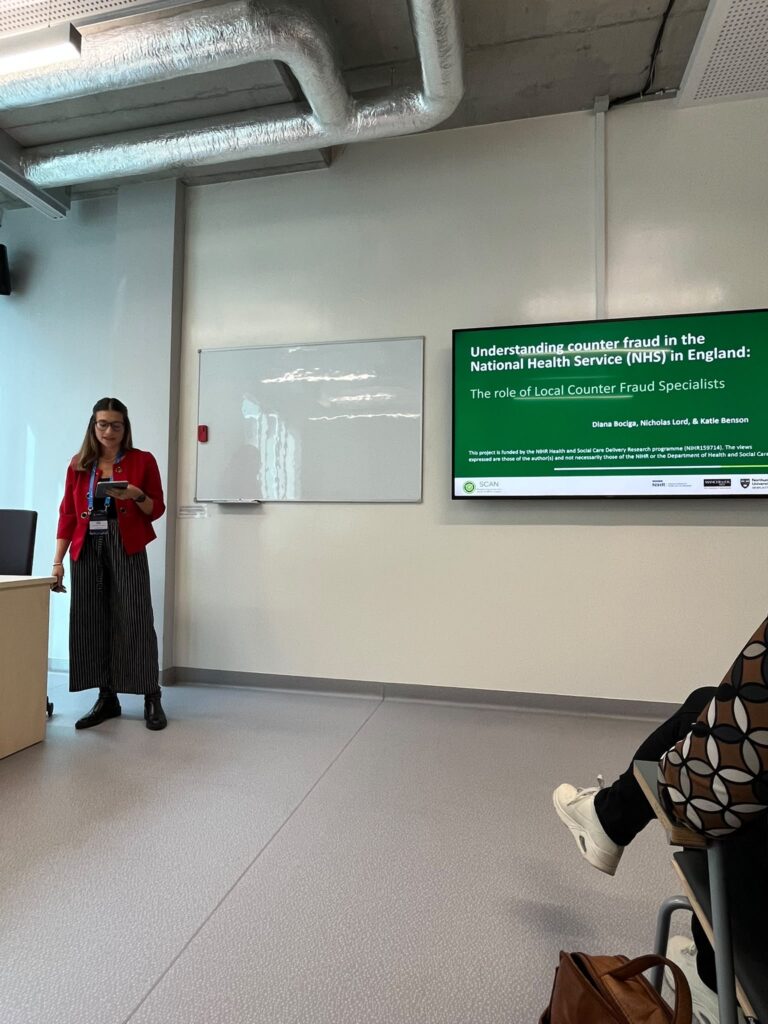
Attendees: Nicholas Lord, Katie Benson and Diana Bociga Date of event : 09/09/26 – 12/09/26 Location: Warsaw, Poland Earlier this month, Nicholas Lord, Katie Benson and Diana Bociga joined the 26th Annual Conference of the European Society of Criminology (Eurocrim 2026) in Warsaw, held under the theme “Frontiers of Criminology.” Diana Bociga presented some of the SCAN project’s preliminary findings on the role of Local Counter Fraud Specialists (LCFSs) in the NHS in England. Eurocrim is the Society’s flagship annual conference, bringing together criminologists, practitioners and policymakers from across Europe and beyond to discuss developments in criminology, criminal justice and related fields. Find out more about the European Society of Criminology and this year’s conference here [link]. The presentation focused on how the LCFS role has evolved. The role once centred on detection and investigation; it has expanded into other activities like awareness raising, risk management and education, all of which depend on LCFSs building and sustaining working relationships across NHS organisations. We also touched on the way LCFSs are contracted and how this shapes their work. Whether an LCFS is directly employed by an NHS organisation, works through a consortium/ non-for-profit, or sits within a private sector provider appears to matter for how the role is practised day to day. We also explored some of the findings around what counts as successful counter fraud work. One pattern that stood out is a shift toward prevention and anti-fraud culture. Some participants mentioned that the strongest marker of success is fraud that never happens, meaning the most visible outcome is often that nothing happens at all. A second, related framing described success as an embedded counter fraud culture within the NHS organisations. That shift – from counting prosecutions and sanctions toward valuing prevention and culture – raises further questions, some of which we posed at the conference. How do we know reduction measures are reducing fraud? And how do we assess something as intangible as counter fraud culture within the NHS? Arguably, this question matters more for fraud than for other crime types. For crimes like homicide or knife crime, a drop in numbers is often evidence that real reduction is happening. The nature of fraud is to look like a legitimate transaction, hiding inside ordinary processes and systems. So an absence of visible fraud does not necessarily mean it has been prevented, it might just mean, for example, detection measures have failed. Detection failure and prevention can look identical, and that’s a risk we need to keep in mind as we shift the narrative around what counts as success. We posed these questions to the audience and received positive feedback and good discussion around reducing fraud, frameworks for thinking about prevention, and the public-private dynamics in controlling fraud. Some of these dynamics are ones we’ll keep exploring. We’re grateful to everyone who engaged with the presentation. The questions and conversations gave us plenty to think about, and we’re looking forward to carrying them into the next phase of the project.

Past Events

SCAN – Med Soc 2026 Conference Report

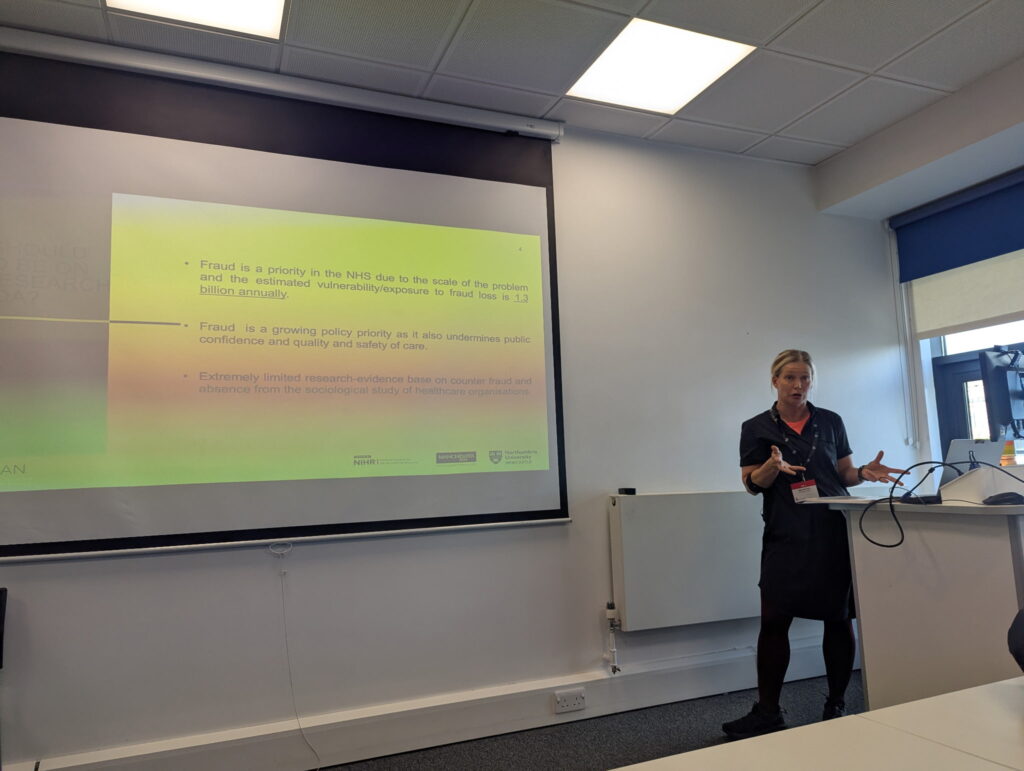
Author: Dr Anu Watson Date of event : 08/09/26 – 10/09/26 Location: Northumbria University, Newcastle upon Tyne  Dr Anu Watson represented the SCAN team on day one of the 58th British Sociological Association Medical Sociology Annual Conference hosted by Northumbria University, presenting preliminary insights on NHS and wider health sector knowledge exchange on counter fraud. For the SCAN team, the event represented a valuable opportunity to contribute to the dialogue on sociological study of healthcare organisations and draw attention to the importance of attending to NHS and wider healthcare fraud (and counter fraud) within this field of study. The team’s presentation offered insights in to learning, knowledge- and good practice exchange within NHS and wider health sector counter fraud. Understanding learning, knowledge and good practice exchange in this setting is important as it has implications as to how we improve practice, organise work, educate and train practitioners, produce guidance for complex contextually bound tasks, and how we monitor performance. Findings and Insights Key insights and takeaways for the SCAN Team included but were not limited to. A broad range of insightful sociological research on healthcare organisations was on display at the Healthcare organisations panel that SCAN team attended on the day. Healthcare workforce was in focus across the majority of the presentations within the panel. For example, Dr Francesca Dakin’s (Oxford University) presentation examined teamwork and relational infrastructure, demonstrating their importance within modern UK general practice. Dr Jennifer Remnant (Strathclyde University) spoke about symptom management, disclosure and organisational control in the NHS. This research vividly illustrated how the healthcare professionals work in a setting that is equipped and designed to deal with ill health, but that these issues were often not understood or acknowledged when it concerned the healthcare workforce itself. The panel also showcased work from outside the UK; PhD student Jingyu Wei’s presentation on Care as Governance, analysing gendered labour in Chinese hospitals, highlighting the importance of researching gendered narratives outside the Western settings. Whereas Kristina Roset, a Doctoral Research Fellow from Arctic University of Norway (UiT) explored the complexity within, what initially could appear as polarised narratives around re-organisation of maternity care in northern Norway. Interest in and responses to the team’s presentation further went on to highlight the pertinence of attending to fraud and counter fraud in this context as a subject of sociological enquiry. Networking and follow up conversations, in and around the panel presentations: following our presentation, offered valuable comments and feedback which was gratefully received and provided plenty of food for thought as the team progress in analysis and writing up of project findings. The team would like to specifically extend a thank you to fellow sociologists of health and illness notably Professor Catherine Pope from University of Oxford, and Dr Gethin Rees from Newcastle University. The SCAN team would like to thank the organisers of MedSoc for another excellent conference day, and Rose Watson from the organising committee for the photos, and chairing our presentation. We look forward to MedSoc 2027. Please note: This project is funded by the NIHR Health and Social Care Delivery Research programme (NIHR159714). The views expressed are those of the author(s) and not necessarily those of the NIHR or the Department of Health and Social Care.

Past Events

Public Sector Counter Fraud Conference 2026

Written by: Dr Cerian Griffiths and Professor Tim Rapley Dr Cerian Griffiths and Professor Tim Rapley recently spoke at the 2026 Public Sector Counter Fraud Conference, which brings together senior practitioners, policymakers, academics, and private sector specialists to address the growing challenge of fraud, bribery, and corruption across UK public services and beyond. The conference was extremely well-attended, as in past years, with attendees drawn from across national and local government, the private sector, and a small number of academics with Cabinet Office Minister Satvir Kaur giving a ministerial keynote address. Sessions throughout the day ranged from AI-driven fraud detection and digital forensics, to governance frameworks, sector-specific challenges, and the evolving legal landscape around corporate fraud liability – With a distinctive global feel, the conference kicked off in earnest with a fascinating discussion between Mark Cheeseman, CEO of the Public Sector Fraud Authority, Michael Horowitz, Inspector General for the Board of Governors of the Federal Reserve System, and Peter Timson, General Manager of the Payments and Integrity Group at Services Australia, on the global commonalities of fraud against the public sector and effective counter fraud responses. One striking commonality was the extent of fraud enabled by government emergency responses to the Covid pandemic, and the audience was shocked to hear the scale of fraud against both the US and Australian systems. Perhaps unsurprisingly, all speakers agreed that the recipe for successful counter fraud lies in three key areas: data sharing between organisations to identify fraud and fraud threat; the education of all public sector staff to identify fraud; and the building of a proactive culture of counter fraud. If there was one topic that came up again and again throughout the day, it was technology. From network-based analytics and AI-driven detection tools to digital forensics and open source intelligence, the message was consistent: data is now central to counter fraud work. Private sector players including Quantexa, SAS, Accenture, and Experian were out in force, and the sessions they contributed to raised genuinely important questions about how public bodies can make the most of the tools now available to them. On a domestic level, sessions around investigative practicalities were very popular. The Network-Based Analytics session led by Julie Barnes of the Insolvency Service was really focused on the realities and practicalities of disclosure in the digital age, a process which all investigators and prosecutors recognise as potentially challenging. Alongside the technology conversations, there was plenty of focus on frameworks and accountability. The Failure to Prevent Fraud provisions, fraud risk assessment methodology, and data sharing all got airtime, with contributions from the NAO, HMRC, DWP, and CIFAS reflecting just how many institutions now have a stake in getting the preventive architecture right. The talk on the Covid Inquiry highlighted how concern fraud was, as ever, far from universal and the importance of embedding fraud prevention into public sector thinking and practice. A dedicated session on the Digital Economy Act, headed up by the PSFA’s Joint Heads of the DEA Debt and Fraud Data Secretariat, offered an extremely insightful exploration of the realities and challenges of data sharing. Resonating with many people’s experience, speakers stressed the extreme variation in resource, expertise, data handling capability, and risk appetite between public bodies and organisations. On a more positive note, the session highlighted what the SCAN project has also found in its research thus far, that many of the concerns organisations have around data sharing are often not as significant as parties believe. There is broad agreement that some myth-busting around the parameters of data protection would go a long way to enabling better data sharing going forward. The programme also made space for sector-specific work that doesn’t always get a platform at cross-government events. Local authority fraud, housing fraud, insider fraud, and identity fraud all had dedicated sessions, giving practitioners from those areas something directly relevant to take away. NHS fraud featured particularly prominently throughout the day. Dr Griffiths and Professor Rapley introduced some of the initial interim findings of the SCAN project to a very well-attended session. High-level findings were shared, including a visualisation depicting the numerous and varied bodies with direct and indirect responsibilities for protecting the health sector against fraud, a striking illustration of the complexity of the landscape. Attendees were given the opportunity to ask questions, and there was considerable interest in both the research methodology and the big question: what comes next? Following the SCAN presentation, the global dimension of counter fraud was returned to in a fireside conversation between Alex Rothwell, CEO of the NHSCFA, and Mark Cheeseman, CEO of the Public Sector Fraud Authority. It was a fitting note on which to reflect on the day’s discussions, bringing the domestic and international threads of the conference back together. Perhaps most encouragingly, the day ended with some genuinely forward-looking discussion on synthetic identities, AI-enabled harm, and whether familiar frameworks like the Fraud Triangle are still fit for purpose. That kind of critical reflection, alongside the operational and policy content, is what makes an event like this worthwhile. A strong day, and a timely reminder of just how much expertise exists across this sector when it gets into the same room, and also the palpable value of different disciplines working together. This project is funded by the NIHR Health and Social Care Delivery Research programme (NIHR159714). The views expressed are those of the author(s) and not necessarily those of the NIHR or the Department of Health and Social Care.

Past Events

SCAN – NHS Counter Fraud Authority LCFS Conference 2026 Conference Report

Authors: Diana Bociga gelvez , Nicholas Lord and Katie Benson Date of event : 28/01/2026  Location: Hilton Leeds City, Leeds  Members of the SCAN team, Katie Benson, Nick Lord and Diana Bociga, attended the NHSCFA Local Counter Fraud Specialist (LCFS) Conference 2026 in Leeds, where they hosted a stand allowing attendees to learn more about the project and register their interest in participating in the research. The conference brought together LCFSs from across England and Wales under the theme Building Collaboratively: Local Insight, National Impact.  Key reflections from the conference    From reaction to prevention: A strong focus on shifting counter fraud work towards prevention and proactive risk identification was set out in a workshop led by Richard Rippin (Associate Director for Operational Services, NHSCFA). This included discussion of national data-driven initiatives such as Project Athena and Project WISE, and the role of analytics in supporting local decision-making.    Local priority fraud risks: Workshop discussions with LCFSs highlighted a range of priority fraud areas, including staffing fraud of various kinds (e.g. false credentials or non-declaration of previous sanctions in recruitment, impersonation fraud, timesheet fraud, and dual working); fraud in ICB-managed care packages and Section 12 Mental Health Assessment processes; and procurement fraud. Discussions also raised concerns about the challenges of investigating alleged fraud involving senior NHS staff, particularly where Trusts may be reluctant to pursue cases that risk the loss of specialist expertise.    Investigative challenges: In a session on managing impersonation fraud, Claire Smallman (Head of Investigations, Mersey MIAA) presented case studies illustrating investigative practice alongside ongoing challenges. These included reliance on standard police reporting routes, as well as inconsistencies in local support where LCFS funding or capacity is reduced during investigations.    Professionalisation and future direction: Andy Gowens (Centre of Specialist Learning Lead, NHSCFA) outlined efforts to professionalise the LCFS role through standards, career pathways, and skills development. Participants raised concerns about the cost of training, prompting reflection on the potential implications for uneven access to professional development across Trusts.  Mark Cheeseman (Chief Executive, Public Sector Fraud Authority) spoke about the current public sector fraud landscape and the future direction of reform and response. Closing reflections from Alex Rothwell (Chief Executive Officer, NHSCFA) emphasised prevention, collaboration, increased use of technology, and the importance of building organisational capability as key future priorities and the importance of strengthening organisational capability as key priorities for the future of counter-fraud work.  For the SCAN team, the conference provided valuable opportunities to interact with LCFSs and understand the reality of local counter fraud work, as well as to raise awareness of the project within the LCFS community.   The conference further provided the SCAN team valuable opportunities to engage with LCFSs, deepen understanding of the realities of local counter -fraud work, and raise awareness of the project within the LCFS community.   Please note: This project is funded by the NIHR Health and Social Care Delivery Research programme (NIHR159714). The views expressed are those of the author(s) and not necessarily those of the NIHR or the Department of Health and Social Care.
Past Events

SCAN – NWFF Annual Conference Report

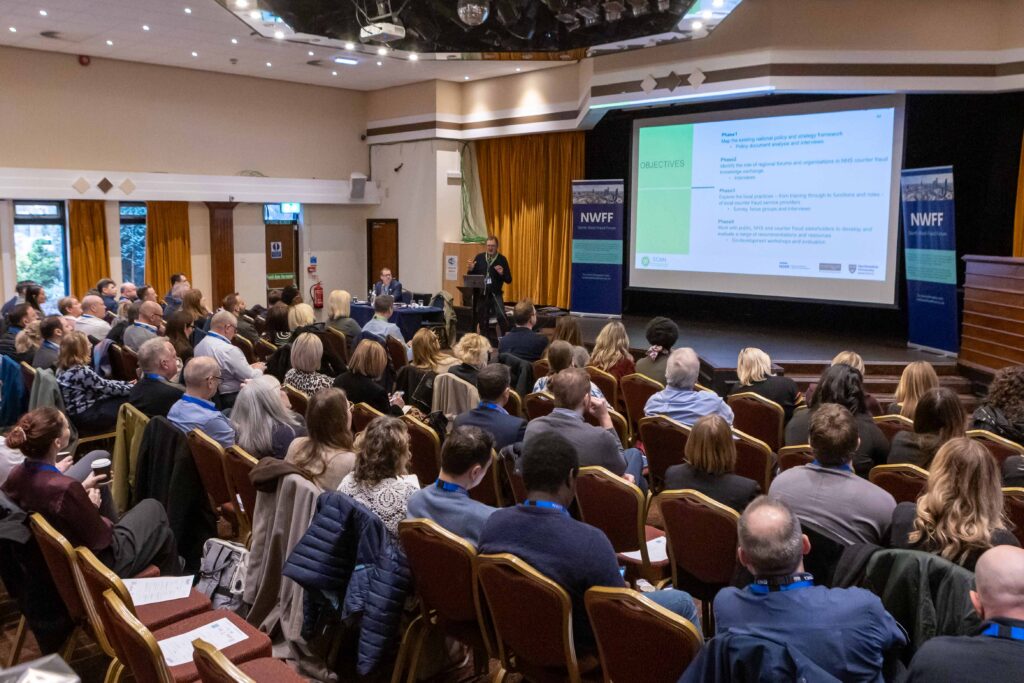
Author: Dr Anu Watson Date of event: 29/1/26 Location: NWFF Conference, Greater Manchester Police and Social Club SCAN Team Conference Report On the 29th of January Tom Sanders and Anu Watson from the SCAN team took to the stage at the North-West Fraud Forum Annual Conference held in Manchester. This was a great opportunity for the team to raise awareness of our project that focuses on strengthening the counter fraud provision across the NHS in England. The North-West Fraud forum brings together a broad range of professionals involved in the fight against fraud and the speakers on the day were reflective of this. Some of our key takeaways from the conference included: Thanks to the NWFF Team for an engaging and insightful Conference! Please note: This project is funded by the NIHR Health and Social Care Delivery Research programme (NIHR159714). The views expressed are those of the author(s) and not necessarily those of the NIHR or the Department of Health and Social Care.

Past Events

SCAN – Medical Sociology Annual Conference Report

Author: Dr Anu Watson Date of event: 11/09/25 Location: Northumbria University, Newcastle Upon Tyne SCAN Team Conference Report Dr Anu Watson from the SCAN team attended the British Sociological Association Medical Sociology Annual Conference hosted by Northumbria University on the 11th of September 2025. The BSA Medical Sociology conference brings together medical sociologists and sociologist of health and illness every year. Some of the key takeaways from the conference included: 1. Attendance at the event and the conference program reaffirmed the extant gap in both research activity and awareness around fraud in the health sector, amongst medical sociologists which SCAN intends to address. The scope for the SCAN project to provide a contribution to medical sociology was evident during conversations with new and existing contacts throughout the day. 2. The breadth of conference streams and presentations clearly illustrates the lively research activity within medical sociology across a range of topics. I attended several panels and presentations during the conference day. 3. Some of the highlights of the day included a special event on health policy, more specifically embedded research methods in harnessing the tacit knowledge that is central to system transformation in health care, showcasing collaborative approaches between universities and local authorities, and role of embedded research in building research capacity in social care. 4. I am always on the lookout for developments in methodological approaches and insights, which could be of value to current/future research I am involved in. I attended several methodology related presentations including ones that explored rhythm analysis and art-based analysis in medical sociology offered some food for thought. T 5. The day concluded with an excellent, thought-provoking presentation from prominent ethnographic scholars Catherine Pope and Bella Wheeler, who unpacked what a responsible supervisors or managers of ethnographic (and other qualitative) research could and should do better. 6. Networking during in between conference presentations provided an excellent opportunity to raise awareness about the SCAN project and more broadly, share the core message about the importance researching fraud in the health sector amongst medical sociologists. The SCAN team look forward to returning in 2026 to report some preliminary project findings! I would like to thank the organisers for an insightful conference day and for NIHR and the SCAN project for supporting my attendance at the event. Please note: This project is funded by the NIHR Health and Social Care Delivery Research programme (NIHR159714). The views expressed are those of the author(s) and not necessarily those of the NIHR or the Department of Health and Social Care.

Scroll to Top