
One of RE:PLAY’s commitments is to be open about our process – not just what we find, but how we find it. So I wanted to share something about how we’re approaching the analysis of our qualitative data in Design to Play, the strand of RE:PLAY that follows our Fellows (with the help of our great Design Fellows) as they redesign their courses to be more playful.
What we’re trying to do
Design to Play has a simple-sounding question at its heart: how does designing for playful learning work? What helps, what gets in the way, and why do some things seem to generate real change while others don’t quite work?
We study that question by working closely with Fellows: academics redesigning their modules, and Design Fellows, the learning designers who support them. We gather data from interviews, reflective journals, and our monthly huddle meetings. That’s a lot of material to make sense of. So how do we do it?
A Goldilocks approach
There’s a concept in research methodology called abductive analysis, coined by the philosopher Charles Sanders Peirce (Peirce, 1903/1997; Tavory & Timmermans, 2014). It’s an honest description of what much good qualitative research does in reality.
Pure deduction would mean we ‘test’ a pre-existing theory against our data. Pure induction would mean we approach the data as a blank slate, letting insights emerge without any prior frame. However, we already have theoretical commitments – ideas about what playful learning is, what makes it work, what the key dimensions of a learning design process look like – so we want to factor those in, without being constrained by them.
Abductive analysis acknowledges that research always has some theory attached and then asks us to be transparent about it, while staying open to what the data might push back with. We move between our existing ideas and what we’re seeing in the transcripts and journals, testing and refining as we go.
How we developed the framework
We didn’t want a ‘theory of everything’, or an evaluation that looked for the ‘one correct design’ for playful learning. That would have been at odds with everything we believe about playful learning itself – its openness, its invitation to voluntary participation, its resistance to being reduced to a checklist. So instead, we worked towards something more flexible.
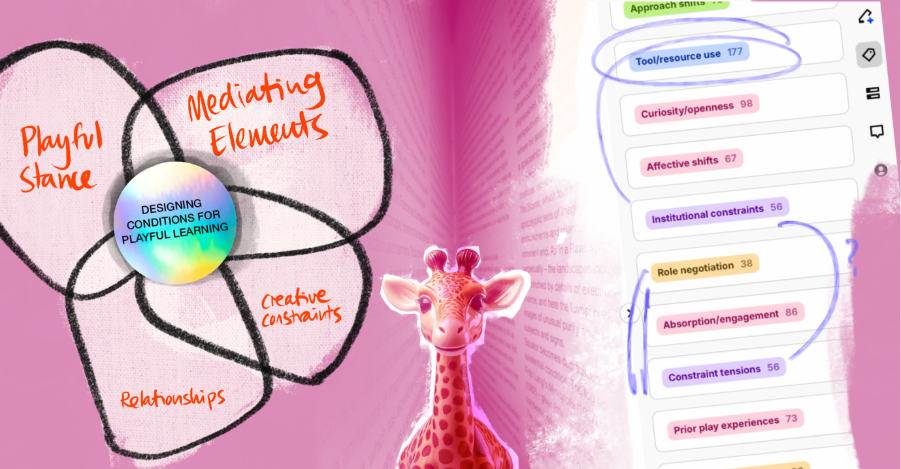
The framework has its origins in the ongoing reflective dialogue that is part of everything RE:PLAY does, and was given shape at our co-investigators and Design Fellows’ residential workshop in September 2025. I found myself drawing Venn-type diagrams to think through the ideas – not because diagrams are tidy, but because overlapping circles hold things together without fixing them in place. The overlap in the middle mattered from the start: it was always going to be the space where dimensions interact, where the conditions for transformative playful learning are created, or closed down. Through that process, we arrived at four dimensions; Mediating Elements (the tools and materials that shape what’s possible), Creative Constraints (the rules and structures that bound the work), Playful Stance (the attitudes and dispositions Fellows bring), and Relationships (the social dynamics being negotiated), with Transformation at their intersection.
More detail, in the form of “codes” in each dimension came from Ian, Nic, Anna, and Lauren (in the first place) – breaking down what we meant by the headings. For example, codes in the ‘playful stance’ evaluative dimension included “Curiosity / Openness” (Expressions of interest, wonder, or willingness to explore), “Risk Tolerance” (Comfort with uncertainty, willingness to experiment or fail) and “Prior Play Experience” (Personal History with Play shaping current disposition). These were not evaluative ‘tick boxes’. In much conventional evaluation, that would be the next move: does your redesigned course tick all the boxes in the way you planned? We weren’t interested in that kind of fidelity checking. We wanted a framework that could hold and illuminate what happens in playful learning design, including the unexpected.
Using the framework analytically
These dimensions aren’t rigid boxes. They work as what the sociologist Herbert Blumer (1954) called sensitising concepts – they direct analytical attention without prescribing what we find, and they stay open to revision as we explore the data. We are using them to code (i.e., tag with labels from our framework) our narrative data from interviews, journals and huddle meetings. That coding gives us a rich descriptive picture of what Fellows are experiencing across each dimension – but description on its own isn’t enough.
The more interesting analytical move involves looking across our dimensions rather than just within them. We’re interested in the relationships between categories: when codes like “Threshold Moments” appear alongside “New Insight”, or when “Absorption and Engagement” seems to link with “Understanding Deepening”. We ask: what do those patterns tell us about the conditions that generate transformation in playful learning design? Also – what combinations of conditions seem to close it down?
To do that, we create theoretical memos – working documents where we record and develop our draft interpretations of what particular combinations might mean. We refine those memos as we go, returning to the data, looking at more examples, and paying particular attention to exceptions: the moments where what we’d expect to see doesn’t quite appear. Exceptions are analytically useful – they tell us where our emerging explanation needs sharpening.
What kind of claims does this produce?
Not statistical ones. We’re not counting enough cases to make frequency claims, and that’s fine – that’s not what this kind of research is for. Instead, we will build conceptually plausible explanations: claims that hold together coherently across multiple instances in the data, and that make sense given what we already know about playful learning (Yin, 2014). To sound fancy, we generalise to a theoretical claim, not to a population. Working this way respects the complexity of designing playful learning, while still reaching for something that’s more than just a collection of interesting stories.
We’ll share more as the analysis develops. In the meantime, if any of this sounds interesting or if you’re doing something similar and want to compare notes, we’d love to hear from you.
References
Blumer, H. (1954) ‘What is wrong with social theory?’, American Sociological Review, 19, pp. 3–10.
Peirce, C.S. (1903/1997) Pragmatism as a Principle and Method of Right Thinking (The 1903 Harvard Lectures on Pragmatism) (Patricia Ann Turrisi, Ed.). New York: SUNY Press.
Tavory, I. and Timmermans, S. (2014) Abductive Analysis: Theorizing Qualitative Research. Chicago: University of Chicago Press.
Yin, R.K. (2014) Case Study Research: Design and Methods. (5th Ed.), Thousand Oaks: Sage.