
Featured News
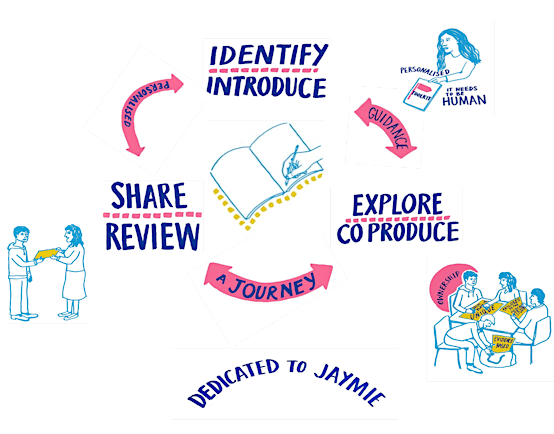
New Personalised Safety Planning Toolkit launches through regional roadshows
About the Study
Jay’s Study came about because of one bereaved mother’s passion to influence change in honour of her daughter, Jay, who died by suicide after experiencing self-harm and seeking help from services.
The devastating impact of suicide on individuals, their family, friends, colleagues, and communities, is a key driver for research to improve implementation of personalised preventative interventions. National guidance from the National Institute for Health and Care Excellence (NICE) recommends safety planning as a practical intervention to help people recognise warning signs, identify coping strategies, and access support during periods of crisis.
Building on a previously developed prototype safety planning framework (McGleenan et al., 2025), Jay’s Study focused on developing this work into a personalised safety planning toolkit, alongside guidance to support how it can be implemented across health and social care.
The outputs of the study are intended to support services in delivering more personalised and consistent safety planning for adults experiencing self-harm and suicidality, and to inform future research exploring the feasibility and effectiveness of the approach.
Our Collaborators





Public and Patient Involvement and Engagement (PPIE)

People with lived experience have played an important role in this study from the very beginning and throughout. They have helped shape the design, delivery, and sharing of the work. This includes being part of the research team, co-production group, and advisory group.
This study builds on an earlier Applied Research Collaborative (ARC) funded study, where four peer researchers helped develop the first version of the safety planning framework. From the outset, people with lived experience helped identify priorities for self-harm and suicide prevention, including the need for a more personalised approach to safety planning. Their input has continued to guide this next stage of the research.
One of these contributors, Paula, whose daughter Jay died by suicide and to whom this study is dedicated, has been closely involved throughout. She said:
“I have shared my daughter’s story and how that led to suicide. It brings a focus to the research – I worked with Katherine to bring this [study] about.”
Before this study began, we worked with charities and PPI groups to make sure we were reaching a wide range of people, including those from underrepresented backgrounds. Their advice helped shape how the study was designed and how people were invited to take part. The study was also planned in partnership with people with lived experience.
Peer researchers were supported throughout with training, guidance, and ongoing support. They worked alongside the wider research team across all parts of the project.
The advisory group, co-chaired by Paula, helped ensure lived experience stayed at the centre of the study. Members were supported to take part in ways that worked for them.
Co-production workshops brought together people from different backgrounds, including staff and those with lived experience, to help design and improve the safety planning toolkit. Their input led to important changes to the toolkit’s content, focus, and who it is for.
People with lived experience have also helped share the findings, including supporting events, developing materials, and advising on accessibility. Feedback has been very positive, both about the toolkit and about how meaningful the involvement has been.
We are continuing to learn from this work. The involvement of people with lived experience is being evaluated, and a research paper led by peer researchers is currently in progress.
What did we do?
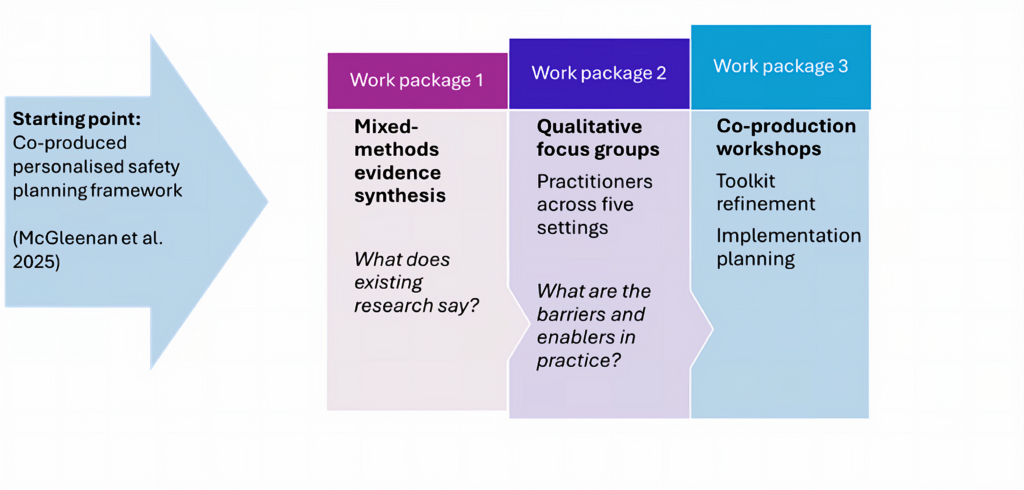
The study delivered three interrelated work packages. Firstly, a mixed-method evidence synthesis explored existing research to develop a theoretical foundation for personalised safety planning and its implementation. Second, focus groups were held with practitioners from:
- Primary care
- Secondary care
- Voluntary organisations
- Ambulance service
- Senior leaders & commissioners
The focus groups explored the barriers and facilitators to implementing personalised safety planning in real world settings. Finally, a series of coproduction workshops brought together practitioners and individuals with lived experience of suicidality and self-harm to refine the toolkit and develop implementation guidance, designed to support its use across health and social care.
“After Jay’s death I learnt a lot about suicide. I came to understand the importance of personalised safety planning. I felt had one been available for Jaymie, her family and friends, it may have helped to save her life.”
Paula – Jaymie’s mum

Paula’s wish for personalised safety planning:
“What I would love to see in 5 years’ time is safety planning being something which is normal, everybody knows about safety planning, especially personalised safety planning”
The project was funded by the National Institute for Health and Care Research (NIHR) under its Research for Patient Benefit (RfPB) Programme (Grant Reference Number NIHR206329). The views expressed are those of the author(s) and not necessarily those of the NIHR or the Department of Health and Social Care.