
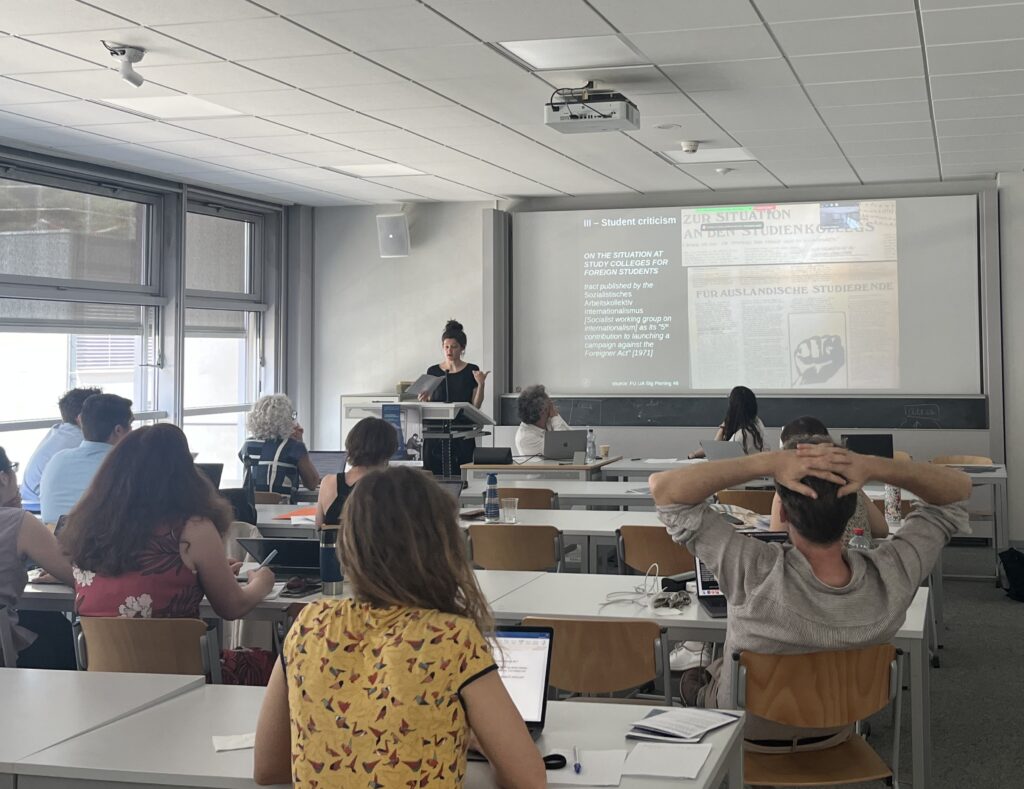
In July 2026, two members of the “University Students as Migrants” team participated in an international workshop that took place at the University of Geneva. Organised by Sara Legrandjacques, Damiano Matasci, Jules Siran and Annalise Walkama, the event was entitled “Lost in Translation: Historical Perspectives on Language and Student Mobility from the Nineteenth to the Twenty-First Century”. With support from the Swiss National Science Foundation, this event was organised independently from our own project, but there were many thematic links that we were able to explore with our fellow participants.
The event provided our team member Lucie Lamy with the opportunity to share work-in-progress from her ongoing research on the “University Students as Migrants” project. Entitled “Teaching German(y): The West German ‘Study Colleges for Foreigners’, 1960–1990”, her conference paper focused on so-called Studienkollegs für Ausländer – one-year courses that were supposed to prepare students from the Global South to embark on higher education in West Germany. Combining language instruction with general studies, the paper considered these courses as normative spaces that not only focused on language competences and skills, but also aimed at conveying German culture and “identity” and at inculcating particular political values. The paper contrasted this perspective with the views and experiences of the students themselves, many of whom not only expressed their discontent with the nature of the instruction but also contested the wider model and assumptions that underpinned these courses. In addition, the paper showed that Studienkollegs quickly evolved into tools of a soft regulation of student migration, illustrating how universities participated in migration management.
During the events closing roundtable, Daniel Laqua reflected on the event as a whole and offered examples from his own research. In doing so, he highlighted the role of language exchanges and visits in the mobility exchanges promoted by student organisations during the interwar years, in some cases in collaboration with bodies such as the League of Nations. Moreover, he articulated connections between the conference theme and our ongoing project on “University Students as Migrants”, citing some examples involving student mobility and language in contemporary Belgium.
The organisers put together a highly stimulating event, and we were grateful for the opportunity to participate!