
Project Objectives and Work Packages
SCAN: Strengthening Counter Fraud across the NHS in England, is a 32-month, almost £900k research project, funded by the National Institute for Health and Care Research (NIHR), led by Northumbria University with the University of Manchester.
SCAN has the following aims and objectives.
Aims and Objectives
Aims:
1. To identify where counter fraud measures across the NHS in England can be improved.
2. To generate evidence, recommendations and resources that will (re)shape the provision of counter fraud.
3. To help reduce the reputational and financial loss for the NHS, and the negative impacts on quality and safety of healthcare, caused by fraudulently/dishonestly or illegally obtained employment, property or NHS funds.


Objectives are to:
1. Map the existing national policy and strategy framework and institutional landscapes within which policies, strategies and approaches are implemented, to identify and address operational issues.
2. Identify the role of regional forums and organisations in NHS counter fraud knowledge exchange and enhance the sharing of good practice in fraud reduction strategies.
3. Explore the daily practices – from training through to functions and roles – of local counter fraud service providers, to assess and strengthen the appropriate allocation of resource and expertise.
4. Work with public, NHS and counter fraud stakeholders to undertake co-design workshops to develop, prototype and formally evaluate a range of recommendations and resources addressing competency, skills and joined up working to strengthen the counter fraud response.
The SCAN project is divided into the following work packages:
WP1 DESCRIBE NATIONAL POLICY (MONTHS 1-12)
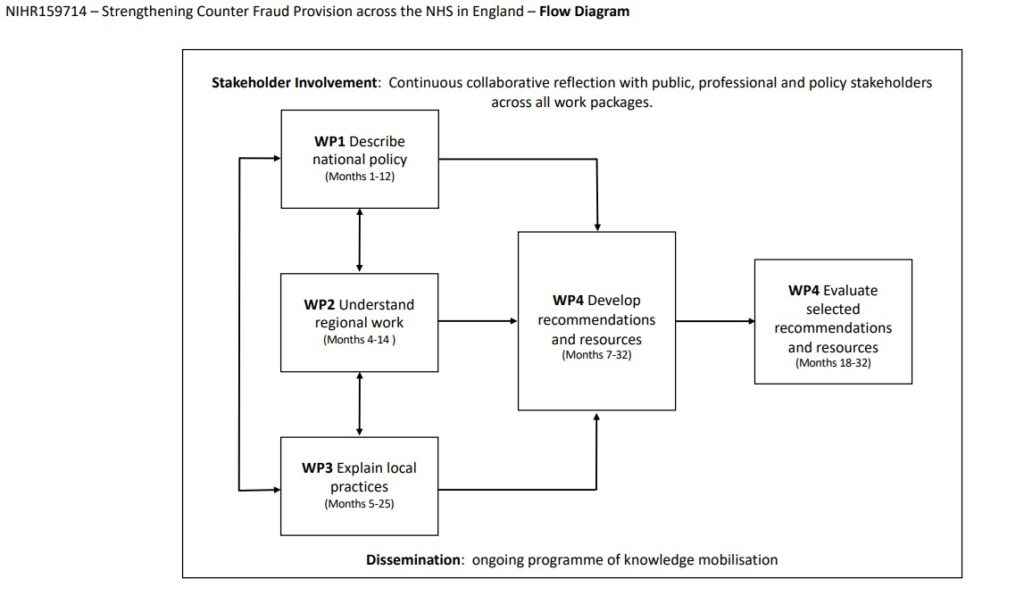
Click through the tabs below to learn about the various work packages
WP1 DESCRIBE NATIONAL POLICY (MONTHS 1-12)
Objective: To map, understand and analyse the national policy and strategy counter fraud response framework, and the organisational and inter-organisational anti-fraud approaches to implementing the framework across the sector. To better understand how standards and training competences align with the requirements of current counter fraud responses and organisational landscapes within which policies, strategies and approaches are implemented.
We will provide a policy narrative with recommendations for policymakers and provide a broader contextual narrative for the other Work Packages (WP2-4). We will characterise the evolution of the current policy and strategy frameworks and the (inter)institutional landscapes and ecosystems it is created within.
Data Collection: This mixed-methods study will collect policy documents, undertake interviews with key policy actors and secondary data analysis of existing data.
WP2 UNDERSTAND REGIONAL WORK (MONTHS 4-14)
Objective: To explore the role of regional forums and organisations in NHS counter fraud knowledge exchange.
Data Collection: This qualitative study will collect web-based information and undertake interviews with professionals.
WP3 EXPLORE LOCAL PRACTICES (5-25 MONTHS)
Objective: To explore the daily practice of local NHS counter fraud service providers.
We will conduct a survey of all Local Counter Fraud Specialists working in NHS trusts and other organisations in England in order to identify, describe and evaluate current process and practices. This will enable a cross section of practice across NHS.
Data Collection: This mixed-methods study will undertake a survey, interviews, and focus groups with counter fraud professionals.
WP4 DEVELOP AND EVALUATE RECOMMENDATIONS AND RESOURCES (MONTHS 7- 32)
Objective: To co-develop, pilot and evaluate recommendations and implementable resources for addressing competency, skills and joined up working to strengthen the counter fraud response.
Over the duration of the study we will work with stakeholders to undertake co-design workshops (Baum et al, 2006, O’Brien et al, 2016) to develop a range of implementable resources to support more effective professional development, knowledge transfer and exchange. We will then embed some of these recommendations and resources into the appropriate contexts and formally evaluate their potential impact.
WP4 CO-DEVELOPMENT WORK (MONTHS 7-32)
To inform the conduct of this work, we will draw on our prior experience of stakeholder engagement (e.g. Birbeck et al 2017, Dovey-Pearce et al 2019, Harrison et al 2023) and ideas from participatory, co-design, co-production, co-development for intervention development we have used in a range of contexts (e.g. Basu et al 2017 https://research.ncl.ac.uk/etipsright/, Smith et al 2020 https://www.rightpath.solutions, Bührmann 2020 https://itfits-toolkit.com). In developing potential resources we will also draw on a range of concepts and theories (e.g. APEASE (Michie et al 2014) criteria – Acceptability, Practicability, Effectiveness, Affordability, Side-effects, and Equity – and, if adapting current interventions, ADAPT guidance (Moore et al 2021); Normalization Process Theory (May & Finch 2009); Expert Recommendations for Implementing Change (Powell et al 2015); Theoretical Framework of Acceptability (Sekhon et al 2017)) to help develop solutions that are feasible, acceptable, workable, and implementable, so as to be sustained over time.
Workshops: We aim to conduct 6-8 co-development workshops, spread across the life of the project. The first workshop will be near the start of the study, thereafter, they will align with key project milestones, especially in relation to the closing analytic stages of each work package.
Workshops: At workshops, the research team will present the most recent elements of learning from the study in order to enable collaborative discussion to: further explore, refine and challenge emerging ideas; develop ideas for resources; engage with and critique prototypes of resources; and shape the design of the formal evaluation of resources.
Supporting Workshop Engagement – Workshop Materials: Prior to each workshop, we will focus on designing clear, accessible and engaging workshop materials. These materials will be developed by prior and related research in the area and from the emerging analytic ideas. We will send out an overview of the workshop alongside core results, ideas, resources and possible questions in accessible formats to participants. This will enable people to initially engage with the findings prior to the workshop, as well as to promote discussion. We will encourage participants to have conversations with others in their professional or lay networks to explore other views prior to attending the meeting. This is important as it enables us to also involve them if they are unable to access the workshop (due to factors such as time, travel, technology or language).
Supporting Workshop Engagement – Prototyping: The research team will also develop mock-ups, models and workable prototypes of resources (Brown & Wyatt 2010). They will be designed so that they can work in face-to-face and online contexts. Throughout this phase, we will also engage in rapid user-testing of some of the prototypes with specific organisations and people, and following feedback, further adapt and refine them.
Workshop Participants: Each workshop will include representatives of people working in counter fraud professions, those working in the NHS, as well as members of the public.
PROJECT OUTPUTS AND WP4 EVALUATION WORK (MONTHS 18-32)
We will develop, pilot and evaluate a suite of implementable resources to support more effective professional development, knowledge transfer and exchange and policy. We will undertake a formal evaluation of a selection of the resources that we have co-developed.